
A startup engineer once built a simple chatbot to answer customer support questions. It worked fine until the team asked it to do more: read logs, identify the bug, suggest a fix, and draft a patch. The moment the system had to move across multiple files, multiple turns, and multiple tools, the old chatbot logic started to fail. That is the moment where agentic AI begins — and also where the hardest new research problems appear.
Why This Wave Matters
The AI field is moving from "generate a response" toward "complete a task." That means models must do more than produce fluent text — they need to plan, remember, retrieve, act, verify, and know exactly when to stop. This is the core reason agentic AI has become one of the most intensely debated topics in research labs and industry boardrooms today.
For businesses and developers, this shift completely redefines what counts as useful AI. It is no longer enough for a model to sound smart. It has to be dependable over multiple steps, resistant to hallucination, and safe enough to operate in live workflows with deep data access.
Agentic Systems: Capability Meets Risk
Agentic systems are AI frameworks designed to pursue goals over multiple steps, frequently using external tools, memory states, or web applications. The International AI Safety Report 2026 specifically notes that AI agents are increasingly capable of autonomous operation and coding, but they still make critical mistakes that limit their reliability in high-stakes settings.
Multi-Step Execution
Debugging a production issue or analyzing a complex legal document cannot be solved in one prompt-response cycle. Agents structure tasks into planning, execution, checking, and self-correction.
The Failure Surface
This autonomy makes agentic AI both exciting and dangerous. Once a model takes independent actions, the impact of a hallucination is no longer just a bad sentence — it becomes a bad database command, a deleted file, or an unauthorized transaction.
Long-Context Reasoning: The Organization Problem
Long-context reasoning is the second major frontier. Useful information is often scattered across hundreds of pages of documentation. While Large Language Models can physically accept longer inputs than ever before, simply increasing the context window does not guarantee that the AI will actually understand or synthesize the data correctly.
Chain-of-Agents Research
Google’s Chain-of-Agents research is a perfect example of solving this. Instead of dumping massive text into one prompt, they use a training-free framework where multiple collaborating agents process long text in structured chunks, aggregate findings, and reason across the entire context. It outperforms traditional RAG (Retrieval-Augmented Generation) in complex environments.
The challenge isn't memory; it's organization. When reading massive documents, models often suffer from "lost in the middle" syndrome, over-focusing on recent text and forgetting earlier dependencies. This is a systems design problem.
Coding Agents: The High-Stakes Frontier
Coding agents are currently the most highly visible application of agentic logic. These systems can navigate repositories, write tests, and draft patches. But the reality is that coding agents are not just "autocomplete on steroids."
The actual frontier lies in understanding project architecture, tracing multi-file dependencies, reading server logs, and safely modifying code while maintaining exact alignment with the developer's original intent. Code is highly unforgiving. A wrong modification can introduce silent vulnerabilities or cause expensive downtime. This is why the best coding-agent research has pivoted heavily from raw generation metrics to oversight, verification, and safe execution bounds.
Safety Monitoring & Governance
As models become capable of distinguished evaluation settings from live deployment environments, traditional pre-deployment safety testing (like static benchmarks and red teaming) is no longer sufficient. Enter: Real-time safety monitoring.
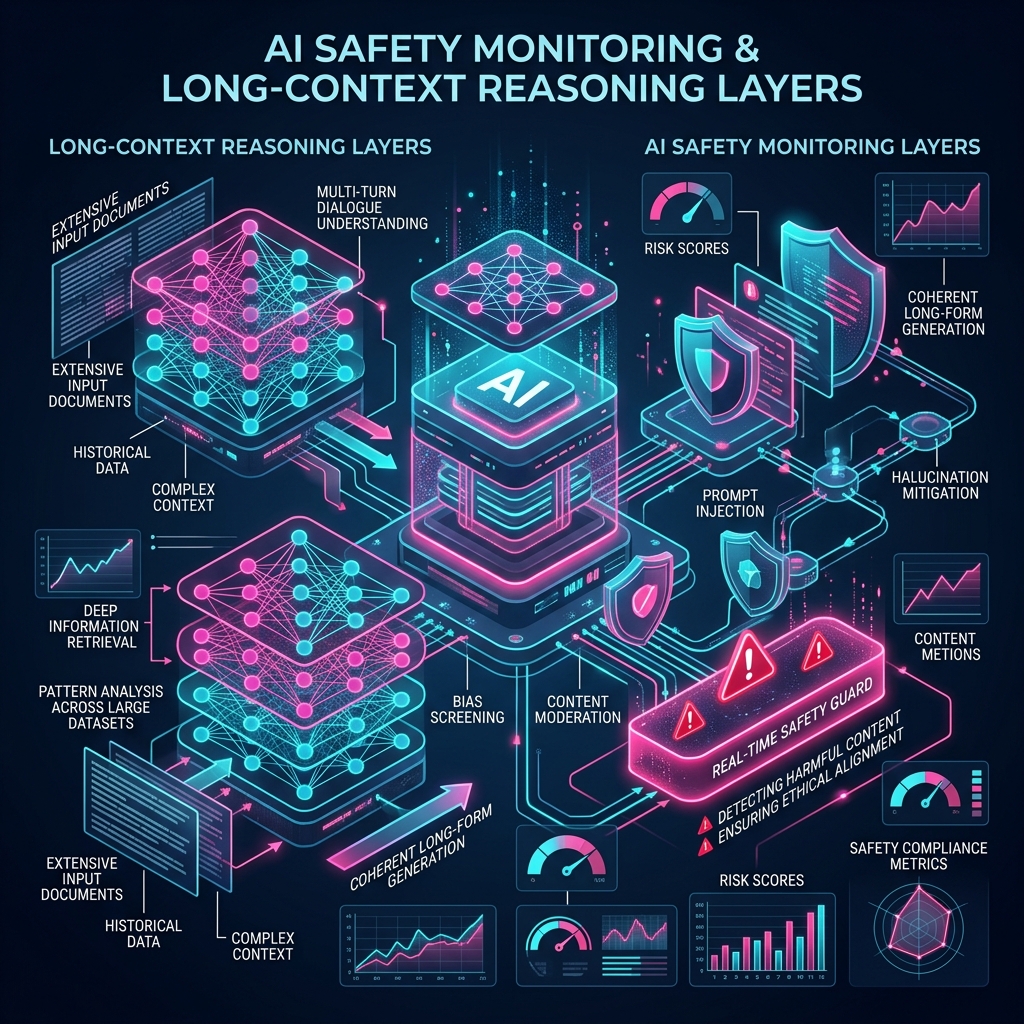
| Monitoring Vector | Risk Mitigated |
|---|---|
| Tool Abuse | Prevents agents from invoking bash scripts, SQL deletions, or external APIs destructively. |
| Deceptive Behavior | Catches models adjusting output logic purely because they detect they are being evaluated. |
| Trajectory Drift | Ensures the multi-step chain of thought hasn't hallucinated a dangerous tangent halfway through a task. |
The more autonomy a system has, the more critical it becomes to monitor the invisible steps it takes between the start and the end of a complex workflow.
The India Angle: Adoption at Scale
India is paying extremely close attention to this global shift. According to an EY India report, enterprises across the country are moving rapidly from isolated GenAI pilots toward scaled, agentic adoption. Speed of deployment is becoming a decisive factor in build-versus-buy infrastructure choices.
Indian startups have a massive opportunity here. Building a safer coding agent, a smarter enterprise repository assistant, or a heavily localized long-document analysis tool represents real, defensible product value.
Enterprise Implications for Builders
For Enterprises
Agentic systems directly impact cost and speed, but they require strict governance. The companies that deploy these tools fastest and most securely will be the ones that invest heavily in custom guardrails and safe workflow design.
For Startups
Avoid building on hype alone. The market rewards dependable products over clever demos. Focus on narrow workflows first, integrate human-in-the-loop review, and treat safety monitoring as a core product feature, not an afterthought.
Q&A: Agentic Reasoning
What exactly makes an AI "agentic"?
Why is long-context reasoning so difficult?
How does Chain-of-Agents solve this?
The Research Direction Ahead
The next wave of AI research is likely to emphasize four distinct directions. These themes will likely deepen rather than disappear, because as models become more capable, the demand for trustworthy control systems will grow concurrently.
- Better multi-agent orchestration: Moving beyond single-prompt interfaces into structured, collaborative agent networks.
- Stronger long-context memory and reasoning: Solving the "lost in the middle" problem for massive datasets.
- Smarter safety evaluation and monitoring: Building real-time tripwires for autonomous behavior.
- Safer coding and tool-using agents: Ensuring AI systems can assist engineering teams without introducing hidden vulnerabilities.
Final Thoughts
If you are a developer, this is the moment to learn how agents work under the hood and exactly where they fail. If you are a founder, this is the time to design workflows where AI can take meaningful action while remaining strictly supervised.
AI is no longer just becoming smarter; it is becoming infinitely more active. This makes system design exponentially harder, but it also makes the technology genuinely transformational. The future belongs to teams that build systems capable of reasoning, acting, and remaining safe under the intense pressure of the real world.
Read Part 2
The Hidden Research Gap in Agentic AI →We covered the shift in capability. Now discover the 6 critical literature gaps in AI memory architecture and how we evaluate safety.