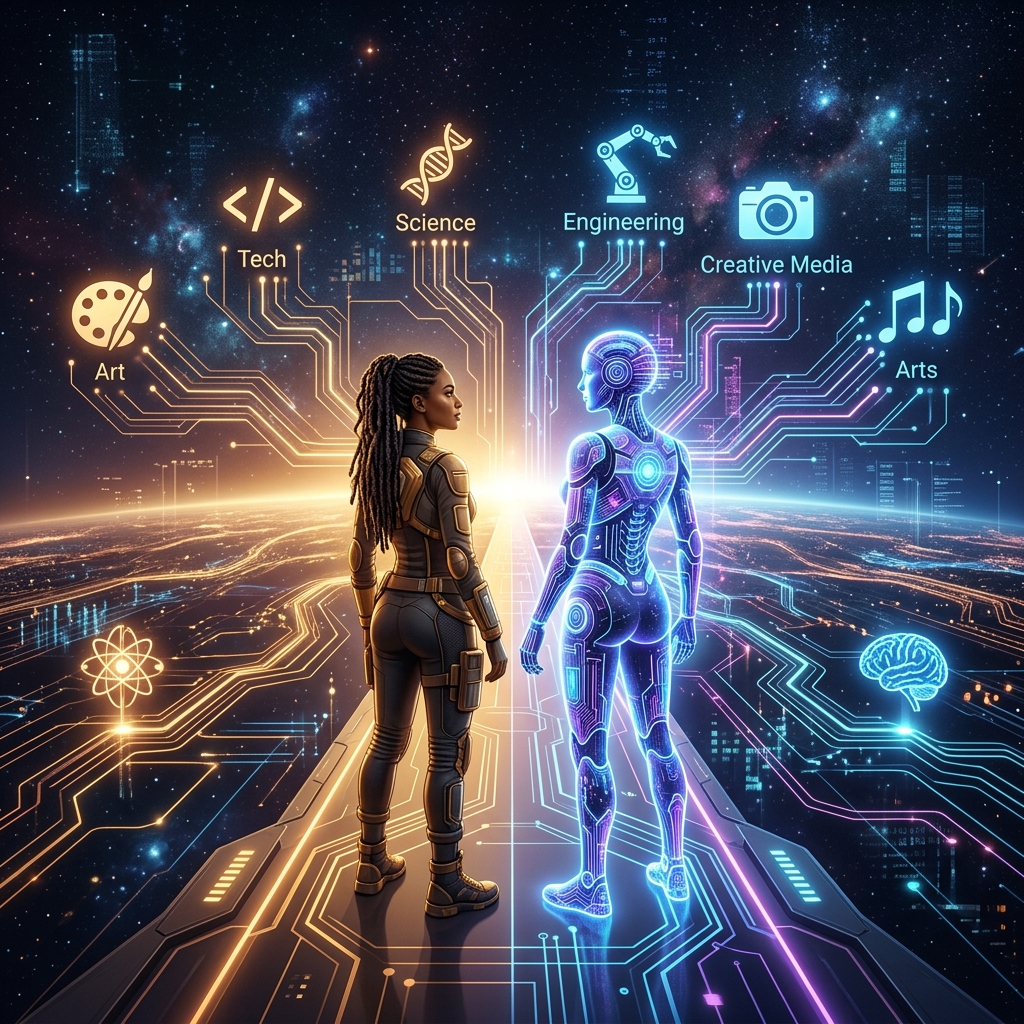
Let's kill the narrative: AI is not here to take your job. It's here to take the boring parts of your job — and, in the process, create entirely new career paths that didn't exist 18 months ago.
JPMorgan just reclassified $19.8 billion in AI spending as core infrastructure. Apple rebuilt Siri from scratch. NVIDIA is hiring for roles that had no job title in 2024. The World Economic Forum estimates AI will create 97 million new jobs globally by 2027 — but the catch is, most of them require skills nobody taught you in college.
This blog is for anyone searching for their next opportunity, wondering where the market is heading, or trying to figure out how to position themselves in an AI-driven world. It's honest, it's detailed, and it's written by someone who's building in this space every day.
1. 20+ New Job Roles the AI Era Created
These aren't hypothetical. These are roles being actively hired for right now at companies from startups to Fortune 500s. The salaries are real, the demand is real, and most don't require a PhD.
🔧 Technical Roles
🎨 Creative & Artistic Roles
Here's the truth the doomers won't tell you: AI made human artistry more valuable, not less. When anyone can generate a passable image in 5 seconds, what becomes rare — and therefore precious — is taste, judgment, narrative, and emotional depth.
💼 Business & Strategy Roles
2. The New Renaissance: Why Art Matters More, Not Less
Every technological revolution that threatened to kill art ended up creating a new golden age. Photography didn't kill painting — it freed painters to explore impressionism. Synthesizers didn't kill music — they created entire genres. AI won't kill art. It will create a new renaissance.
Here's why: when AI can produce technically competent work in seconds, the scarcity shifts. Technical skill is no longer rare — but vision, taste, cultural context, emotional resonance, and lived experience become priceless. The world will value artists more, not less — but it will value different things about them.
🔹 Concept & Vision — What to create and why (irreplaceable human judgment)
🔹 Curation & Taste — Separating the exceptional from the mediocre (human sensitivity)
🔹 Narrative & Context — Stories rooted in lived experience (uniquely human)
🔹 Execution & Craft — The making itself (now augmented, not replaced, by AI)
The artists who thrive in 2026 are hybrid thinkers — they use AI as a studio assistant, not a replacement for their voice. A filmmaker uses AI to generate previews of 50 camera angles in minutes, then applies their cinematic eye to choose the one that tells the story. A musician uses AI to explore chord progressions they'd never considered, then brings the human emotion that makes a song unforgettable.
3. An Honest Look: The Pros and Cons of AI
I'm bullish on AI, but I'm not blind. Let's be honest about both sides.
- Democratizes expertise: A farmer in Bihar can now access medical, legal, and financial advice that was previously available only to the wealthy.
- Creates entirely new industries: 97M new jobs predicted by WEF. Roles like AI Auditor, Synthetic Director didn't exist 2 years ago.
- Amplifies human creativity: Artists, writers, and musicians can explore ideas 100x faster, focusing on vision over execution.
- Solves intractable problems: Drug discovery, climate modeling, materials science — AI is accelerating solutions to humanity's hardest challenges.
- Equalizes opportunity: A self-taught developer with AI tools can now build products that rival well-funded teams.
- Reduces drudgery: Nobody dreams of filling spreadsheets. AI handles the repetitive so humans can do meaningful work.
- Job displacement is real: Repetitive, rule-based roles ARE being automated. Call centers, data entry, basic analysis — the impact is already visible.
- Deepfakes & misinformation: The ability to generate convincing fake content at scale is a serious societal threat.
- Wealth concentration: AI benefits disproportionately flow to those who own the infrastructure and models.
- Privacy erosion: More data collection, more surveillance capability, more potential for abuse.
- Skill atrophy: Over-reliance on AI can erode foundational skills — writing, reasoning, problem-solving from first principles.
- Bias at scale: AI doesn't eliminate human bias — it automates and amplifies it unless carefully governed.
4. Evaluate Yourself First: The Honest Self-Assessment
Before you blame the market, before you blame AI, before you send your 500th job application — stop and evaluate yourself honestly. The strongest career moves I've seen in 2026 come from people who did the inner work first.
- ?Can you build something from scratch? Not use a template — actually build. In 2026, proof of skill matters more than credentials.
- ?Do you understand AI well enough to use it daily? If you're not using AI tools in your workflow yet, you're already behind the curve.
- ?Can you articulate what makes YOU uniquely valuable? In a world where AI can do "average" work, your differentiator is your specific perspective and experience.
- ?When did you last learn something fundamentally new? Not a tutorial. A genuine paradigm shift in how you think about your craft.
- ?Are you solving problems or following instructions? AI follows instructions perfectly. Humans identify which problems are worth solving.
- ?Do you have a portfolio of WORK, not just a resume of TITLES? Artifacts > Credentials. Show, don't tell.
- ?Are you adaptable? The people who thrive aren't the most skilled — they're the most willing to evolve.
If you answered "no" to more than 3 of these — that's not a problem, it's a starting point. The fact that you're reading this means you're already ahead of most people who are passively waiting for the market to change.
5. Let's Talk — I'm Open for Career Conversations
The best career conversations happen in real time. No endless emails, no waiting — just instant connections.
Need a resume review? Want to practice for an interview? Looking for a referral? Sometimes, all it takes is a 10-minute conversation to unlock the next big thing.
#CareerBreakthrough #InstantReferrals #NetworkingThatWorks
AI Career FAQ
Will AI replace all jobs?
No. AI will transform jobs, automate repetitive tasks, and create entirely new roles. The World Economic Forum estimates 97 million new jobs by 2027. However, roles that are purely rule-based and repetitive are at highest risk. The key is to develop skills that complement AI rather than compete with it.
What skills should I learn to stay relevant in the AI era?
Focus on: (1) Human judgment and strategic thinking, (2) AI literacy — learn to use AI tools daily, (3) Creative problem-solving, (4) Emotional intelligence and leadership, (5) Domain expertise combined with AI proficiency. The most valuable professionals are "centaurs" — human-AI hybrids who use AI to amplify their unique expertise.
Do I need a CS degree to work in AI?
No. Many of the emerging roles (AI Product Manager, AI Auditor, Creative Automation Lead, Experience Technologist) don't require a traditional CS background. What matters more is demonstrated ability to work with AI tools, domain expertise, and a portfolio of real work. Build things, show results.
How do I transition into an AI-related career?
Start by integrating AI into your current workflow. Use tools like ChatGPT, Claude, or GitHub Copilot daily. Build side projects that showcase your AI literacy. Document your journey publicly. Network with people in the space. And sometimes, a single career conversation can change everything — book a call at topmate.io/govind_mehta.
Written by Govind Mehta
AI Systems Engineer · Startup Founder · Open for collaborations & career discussions