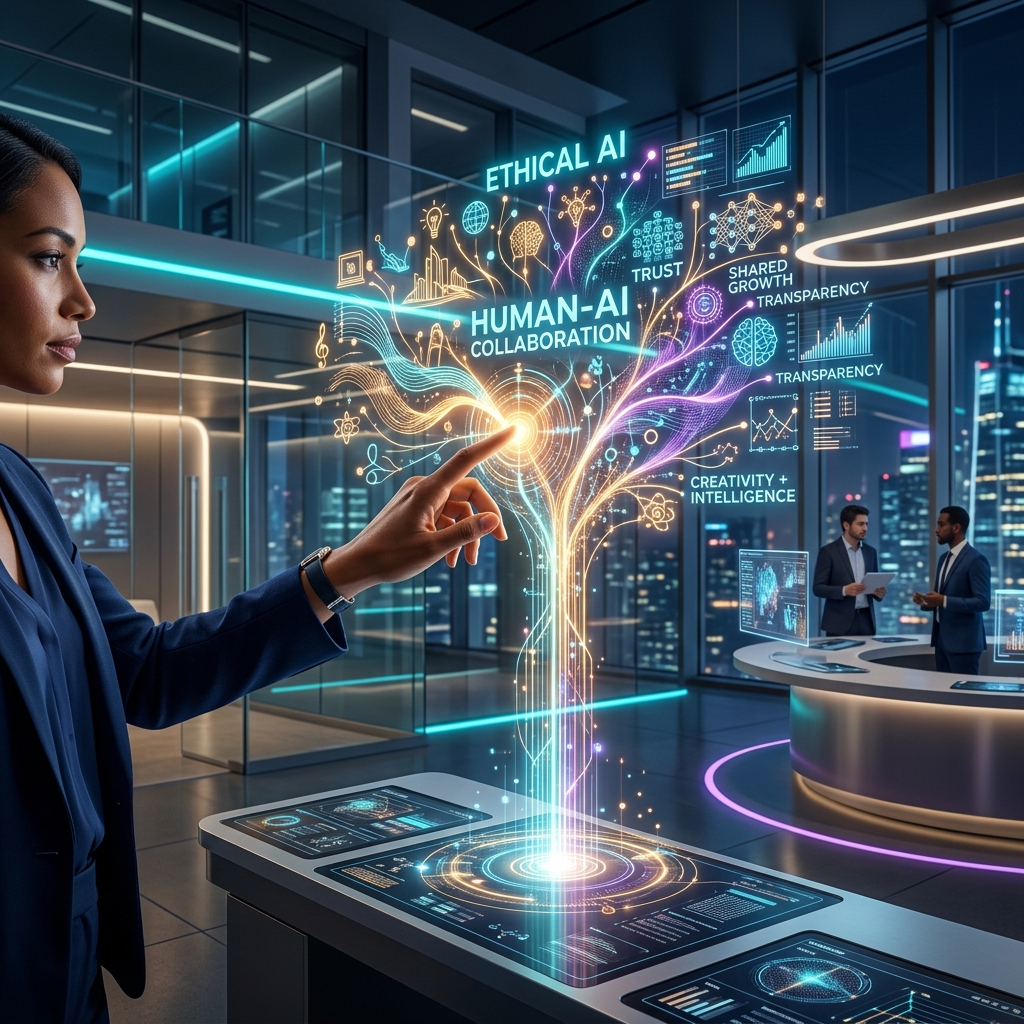
Human creativity and artificial intelligence growing together in a shared ethical framework.
Introduction: Why AI Ethics Matters Now
Artificial Intelligence is transforming every aspect of our lives—from healthcare and education to art, entertainment, and governance. But as AI grows more powerful, critical questions emerge: Should AI replace humans, or should it help humans grow? How do we ensure AI respects human dignity, creativity, and fairness?
The answer is clear: We should grow with AI, not be replaced by it. This blog explores real research on AI ethics, public opinions, and a practical framework for approaching AI ethically—one that values human talent, protects creative fields, and ensures people and governance prioritize skills over automation.
Part 1: What Is AI Ethics? Real Research & Core Principles
Definition
AI ethics is a set of values, principles, and techniques that guide the responsible development and use of AI systems. It ensures AI benefits society while minimizing harm like bias, privacy violations, and job displacement. ISO
UNESCO's Global Framework (2026)
The UNESCO Recommendation on the Ethics of Artificial Intelligence, updated in June 2026, establishes that AI must respect human rights and human dignity. It is grounded in key principles:
| Principle | What It Means |
|---|---|
| Transparency | People should understand how AI algorithms work |
| Fairness | Training data must avoid discrimination and bias |
| Human Oversight | Humans must control AI systems, not the reverse |
| Privacy | Personal data must be protected throughout AI's lifecycle |
| Environmental Sustainability | AI should not harm the planet |
| Non-Maleficence | AI must avoid harming individuals, society, or environment |
| Accountability | Developers and policymakers must ensure responsible AI use |
| Inclusiveness | Diverse perspectives must shape AI development |
ISO's Responsible AI Framework
The ISO (International Organization for Standardization) adds eight more ethical pillars, emphasizing robustness, designing for humans, and using diverse user feedback throughout development to prevent harm and ensure data control.
Part 2: The Biggest Ethical Challenges in AI Today
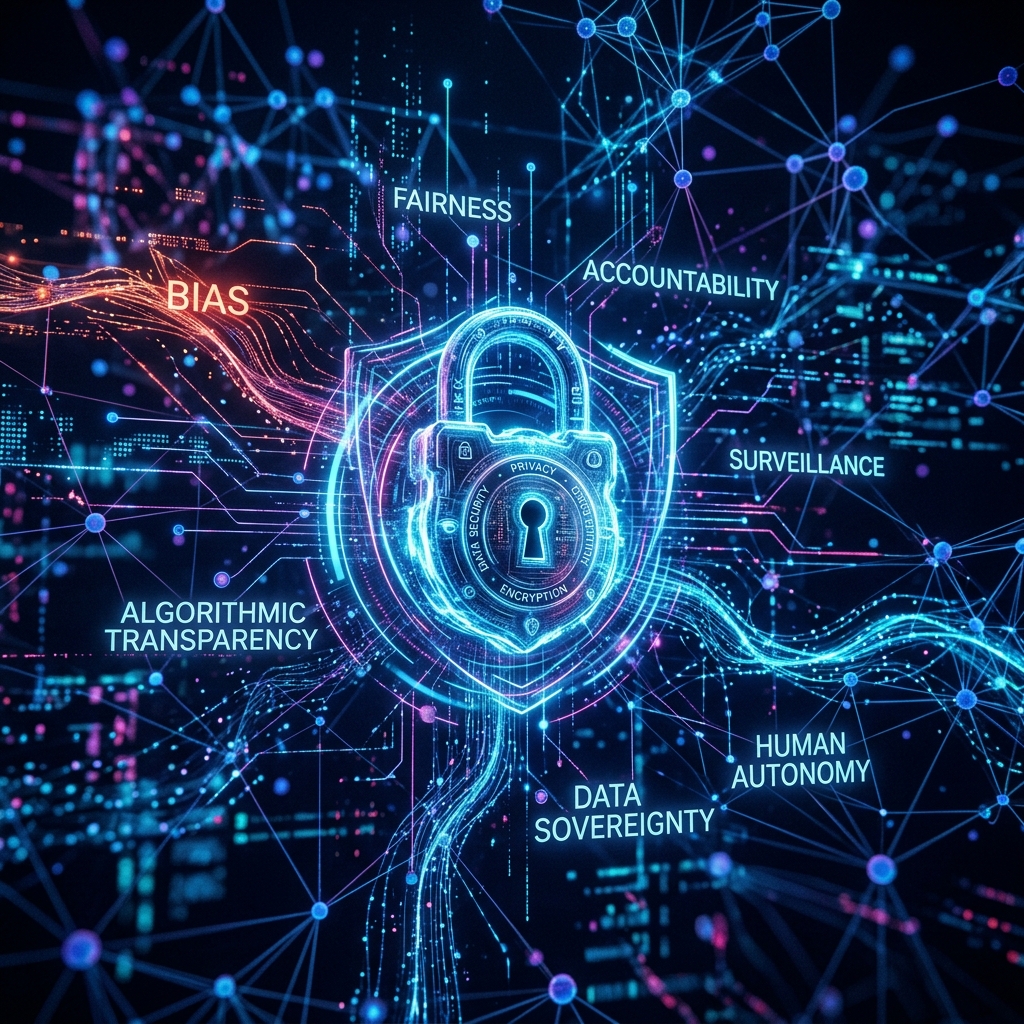
Visualizing the complex balance between data-driven AI and human privacy.
1. Job Displacement vs. Job Reshaping
Public Concern: Many people fear AI will replace them. A 2026 BCG study reveals a different reality:
2. Bias and Discrimination
AI systems trained on biased data perpetuate discrimination, such as hiring algorithms favoring certain demographics or facial recognition failing on people of color. The solution is using diverse, representative datasets and testing for bias across subgroups.
3. Privacy Violations
AI collects massive personal data. Without safeguards, this leads to unauthorized sharing and loss of individual control. Implementing privacy-by-design is crucial.
4. Threat to Human Creativity
AI-generated art, music, and writing raise concerns about devaluing human talent. Stanford Research shows that strong intellectual property (IP) protections will incentivize human creativity, which is essential for improving and applying AI. SSIR
Part 3: Public Opinion on AI – What People Really Think
- Job Replacement Fears: Workers want AI to enhance, not eliminate, their roles.
- Creativity Concerns: Artists want AI to be a tool, not a replacement. People value authentic human expression.
- Demand for Guidelines: The public wants transparency and accountability for AI harms.
- Hope for Collaboration: Many see AI as an assistant that boosts output and creates new opportunities.
Part 4: Your Vision – Growing with AI, Not Being Replaced
This is a human-centered philosophy aligning with global ethical frameworks. AI should enhance human capability, protect creativity, and value talent over automation.
Part 5: A Practical Framework – How to Approach AI Ethically
For Individuals
- Use AI as a reliable assistant to boost output, but never compromise your own insights.
- Fact-check AI output with credible sources.
- Give credit when borrowing ideas from AI.
- Check for bias in AI output.
For Artists & Entertainment Professionals
- Use AI for idea generation, not final creation. Maintain your unique artistic voice.
- Protect your work by registering copyrights and advocating for stronger IP laws.
- Demand ethical policies, like requiring AI to credit human creators and paying royalties.
For Policymakers & Governance
| Policy Area | Action |
|---|---|
| Job Protection | Mandate AI reshaping plans that include worker training, not layoffs |
| Creative Rights | Strengthen IP laws to protect human creators from AI exploitation |
| Transparency | Require AI disclosure labels (e.g., "AI-generated" content) |
| Bias Audits | Mandate regular bias testing for AI systems in hiring and healthcare |
Part 6: Real-World Examples of Ethical AI Approaches
- UNESCO's Education Ethics: Students use AI to help, not do all the work.
- BCG's Job Reshaping: Companies retain employees and offer training to use AI for productivity.
- Stanford's IP Protection: Strong copyright laws protect human artists, incentivizing real creativity.
- ISO's Standards: Organizations using ISO standards report lower bias and higher trust.
Part 7: The Future – AI as a Partner, Not a Replacement
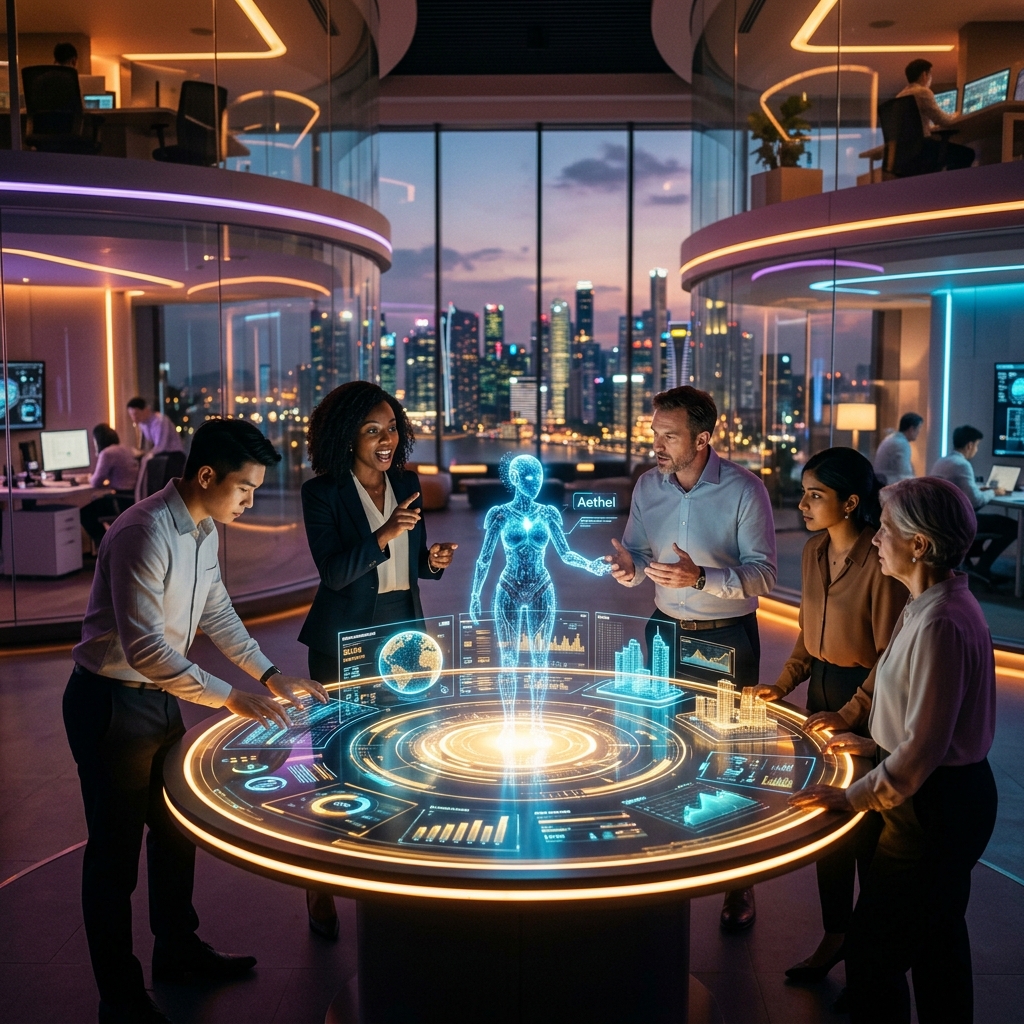
The future workplace where diverse human teams collaborate seamlessly with AI intelligence.
If we follow ethical frameworks, artists thrive while AI assists creation. Workers grow because jobs are reshaped with training, not layoffs. Creativity flourishes, and society benefits by solving problems while respecting human dignity.
Without ethical guardrails, human creators lose opportunities, bias harms marginalized communities, and privacy is violated at scale. Your vision of growing with AI is the ethical path forward.
Policy-Making Framework for AI: Balancing Innovation with Job Protection
Executive Summary: A New Paradigm for AI Governance
The challenge of AI policy is not to slow innovation or block progress—it's to channel AI toward human-centered outcomes where technology amplifies rather than replaces human potential. This document presents a research-backed policy framework that balances AI innovation with job protection, drawing from UNESCO, BCG, Stanford, and ISO research while integrating your vision of growing with AI, protecting talent, and valuing skills.
Part 1: The Core Policy Problem – Innovation vs. Protection
The False Dichotomy
Many policymakers treat AI innovation and job protection as opposing goals:
| Innovation-First Approach | Protection-First Approach |
|---|---|
| Maximize AI adoption speed | Slow AI deployment |
| Minimize regulation | Heavy restrictions |
| Assume jobs will naturally shift | Assume jobs will be lost |
| Risk: Mass displacement | Risk: Stagnation |
Research shows this is wrong: BCG's 2026 study proves AI will reshape 50–55% of jobs while most employees retain their roles. The key is structured transition, not blocking AI. BCG
The Real Challenge
Answer: Policies that mandate job reshaping with training, not layoffs.
Part 2: Research-Based Policy Principles
Principle 1: Job Reshaping Mandate (Based on BCG Research)
The Problem: Without policy, companies will use AI to cut costs through layoffs.
The Research: BCG found 50–55% of US jobs will be reshaped by AI in 2–3 years, but most employees will retain roles if they receive training. BCG
Section 1: Mandatory Reshaping Plans
- Companies implementing AI must submit "Job Reshaping Plans" to labor authorities
- Plans must include: training programs, timeline for worker adaptation, no-layoff commitments for 2 years
- Exception: Layoffs allowed only after training proves worker cannot adapt
Section 2: Training Funding
- AI-implementing companies pay 2% of AI-related cost savings into "Worker Training Fund"
- Fund provides: free courses, certification programs, apprenticeship placements
Section 3: Enforcement
- Labor Department audits reshaping plans annually
- Violations: 5% of company's annual revenue per affected worker
Why This Works:
- Companies still innovate with AI (no adoption barriers)
- Workers get training to adapt (not replaced)
- Government ensures accountability (enforcement)
- Economic growth continues (AI cost savings fund training)
Principle 2: Creative Talent Protection (Based on Stanford IP Research)
The Problem: AI-generated art, music, and writing devalue human creators, reducing income and opportunities for artists.
The Research: Stanford Social Innovation Review proves strong IP protections incentivize human creativity, which is essential for improving and applying AI itself. SSIR
Section 1: AI Disclosure Requirements
- All AI-generated content must display "AI-Generated" label
- Content using AI assistance must display "AI-Assisted" label
- Failure: $10,000 per violation + content removal
Section 2: Copyright Expansion
- Human creators retain copyright even when using AI tools
- AI companies must pay royalties when training on copyrighted work
- Artist consent required before AI uses their work for training
Section 3: Creative Industry Grants
- $5 billion annual fund for human artists, musicians, writers
- Grants for: exhibitions, albums, publications, performances
- Priority: Traditional arts, regional languages, cultural heritage
Section 4: Ethical AI in Entertainment
- Entertainment companies must maintain 70% human-created content minimum
- AI can assist but cannot replace human directors, writers, actors
- Violation: Ban from government funding and tax incentives
Why This Works:
- Artists earn from their talent (not replaced by AI)
- AI companies still innovate (can use AI as tool)
- Culture preserves human expression (cultural diversity)
- Innovation continues (AI assists, not replaces)
Principle 3: Skills-First Governance (Based on UNESCO Human Dignity Framework)
The Problem: Governments prioritize AI efficiency over human dignity, leading to automation-first policies that discard workers.
The Research: UNESCO's 2026 AI Ethics Recommendation states AI must respect human rights and human dignity, grounded in transparency, fairness, and human oversight. UNESCO
Section 1: Public Sector AI Limits
- Government agencies cannot use AI for: hiring, firing, welfare eligibility, judicial decisions
- AI can assist but final decisions require human review
- Exception: Low-stakes administrative tasks (scheduling, data entry)
Section 2: Education Investment
- $20 billion annual fund for skills education
- Priority programs: arts, crafts, storytelling, music, acting, writing
- Curriculum: AI as tool + human skill mastery
Section 3: Value-Talent Mandate
- Government contracts must score vendors on "human talent value"
- Criteria: % human workers retained, training provided, creativity supported
- AI-only vendors automatically disqualified from cultural/creative contracts
Section 4: Talent Recognition System
- National "Master Talent" certification for artists, craftsmen, performers
- Benefits: tax breaks, grant priority, public recognition
- Goal: Make human talent economically and socially valued
Why This Works:
- Government prioritizes human workers (not just AI efficiency)
- Education values creative skills (not just technical)
- Contracts reward talent retention (companies hire humans)
- Society recognizes human worth (cultural dignity)
Part 3: Balancing Innovation with Protection – The 4-Pillar Framework
Pillar 1: Innovation Acceleration (Keep AI Growing)
| Policy | What It Does | Innovation Impact |
|---|---|---|
| AI Tax Credits | 25% credit for AI research & development | Companies invest more in AI |
| Regulatory Sandboxes | Test AI in controlled environments without full compliance | Faster experimentation |
| Public AI Infrastructure | Government provides AI computing resources to startups | Lower barriers to entry |
| Open Data for AI | Public datasets available for AI training | Better AI models |
Goal: Make AI innovation faster and cheaper for companies.
Pillar 2: Job Protection (Keep Workers Employed)
| Policy | What It Does | Protection Impact |
|---|---|---|
| Job Reshaping Mandate | Companies must train workers, not lay them off | Workers retain jobs |
| Layoff Penalties | 5% revenue penalty for AI-related layoffs | Companies avoid layoffs |
| Training Fund | AI cost savings fund worker education | Workers adapt successfully |
| Unemployment Insurance Plus | Extended benefits + training during AI transition | Workers not punished |
Goal: Make job loss expensive and training cheap for companies.
Pillar 3: Creative Protection (Keep Humans Creating)
| Policy | What It Does | Creative Impact |
|---|---|---|
| AI Disclosure Laws | AI content must be labeled | Consumers choose human |
| Royalty System | AI companies pay for copyrighted training data | Artists earn royalties |
| Creative Grants | $5B/year for human artists | Artists funded directly |
| Human Content Minimums | 70% human-created content in entertainment | Human work stays central |
Goal: Make human creativity economically viable.
Pillar 4: Skills Valuation (Keep Society Valuing Talent)
| Policy | What It Does | Valuation Impact |
|---|---|---|
| Master Talent Certification | National recognition for skilled humans | Talent gets prestige |
| Government Contract Scoring | Score vendors on human talent retention | Companies hire humans |
| Education Priority | Fund arts, crafts, music in schools | Skills taught early |
| Tax Breaks for Talent | Reduce taxes for human creators | Artists earn more |
Goal: Make human skills culturally and economically valued.
Part 4: Real-World Policy Examples (What Works Already)
Example 1: European Union's AI Act (2024)
What They Did: Required AI disclosure for generated content, mandated human oversight for high-stakes AI (healthcare, justice), banned certain AI uses (social scoring, untargeted surveillance).
Result: AI innovation continued but with ethical guardrails. UNESCO
Lesson: Regulation doesn't block innovation—it channels it responsibly.
Example 2: Singapore's AI Governance Framework
What They Did: Created "AI Testing Framework" for companies to validate fairness, provided government grants for AI training programs, established AI ethics advisory boards with public representation.
Result: Companies innovate faster because they know rules upfront; workers get training support.
Lesson: Clear rules + support = faster, safer innovation.
Example 3: Canada's Artificial Intelligence and Data Act (2023)
What They Did: Mandated bias testing for AI systems, required impact assessments before AI deployment, created compensation fund for AI harms.
Result: Companies test AI before deployment, reducing harm; workers trust AI more.
Lesson: Prevention + accountability = sustainable AI.
Part 5: Your Vision as Policy – The "Grow-With-AI" Framework
"We should grow with AI and make policies to create new systems with AI so that people should not be replaced with AI. They should grow and give more chances for art and entertainment people to grow with real natural talent. People and governance should value talent and skills."
Policy Translation: The HUMAN-AI Partnership Act
- AI must enhance human potential, not replace it
- Workers must grow with AI, not be displaced
- Creative talent must be protected and valued
- Governance must prioritize skills over automation
SECTION 2: JOB GROWTH MANDATE
- Companies implementing AI must create "Worker Growth Plans"
- Plans must show: training programs, skill development, career advancement
- Layoffs prohibited for 3 years after AI implementation (unless worker refuses training)
- Violation: 10% of company's annual revenue
SECTION 3: CREATIVE TALENT PROTECTION
- All AI-generated art/music/writing must display "AI-Generated" label
- AI companies must pay 15% royalty to original creators when training on their work
- Government grants $10B/year for human artists, musicians, writers, performers
- Entertainment industry must maintain 75% human-created content minimum
SECTION 4: SKILLS VALUATION SYSTEM
- National "Master Skills" certification for artists, craftsmen, performers, teachers
- Government contracts score vendors on "human talent value" (50% of score)
- Tax breaks: 30% reduction for companies maintaining >80% human workforce
- Education: 40% of school curriculum must be human skills (arts, crafts, storytelling)
SECTION 5: INNOVATION SUPPORT
- $50B AI research fund for companies committing to human-centered AI
- Regulatory sandboxes for AI testing (faster approval for ethical AI)
- Open public datasets for AI training (no cost to startups)
- Tax credits: 25% for AI R&D that includes worker training programs
SECTION 6: ENFORCEMENT
- Labor Department audits Worker Growth Plans annually
- Cultural Ministry monitors creative content ratios
- Independent AI Ethics Board with public representation
- Penalties: Revenue-based (5–10% annual) + public disclosure
Part 6: Implementation Timeline – How This Becomes Real
Phase 1: Year 1 (Passing the Laws)
| Quarter | Action |
|---|---|
| Q1 | Draft legislation with stakeholder input (workers, artists, companies) |
| Q2 | Public hearings + debate in legislature |
| Q3 | Pass HUMAN-AI Partnership Act |
| Q4 | Establish enforcement agencies (Labor AI Office, Cultural AI Office) |
Phase 2: Year 2–3 (Building Systems)
| Action | Timeline |
|---|---|
| Create Worker Training Fund infrastructure | 6 months |
| Launch Creative Grants application system | 6 months |
| Implement AI disclosure labels (mandatory) | 1 year |
| Certify first "Master Skills" talent holders | 1 year |
| Audit first 100 companies' Worker Growth Plans | 2 years |
Phase 3: Year 4–5 (Measuring Impact)
| Metric | Target |
|---|---|
| Job displacement rate | <5% (vs. 20% without policy) |
| Worker training completion | >80% |
| Human-created content in entertainment | >75% |
| Artist income increase | +30% |
| AI innovation growth rate | +15% annually (not slowed) |
| Public trust in AI | >70% (vs. 40% without policy) |
Part 7: Why This Balances Innovation + Protection
The Innovation Side (Technology Still Grows)
| Without Policy | With This Policy |
|---|---|
| Companies cut jobs to save costs | Companies train workers (still save costs) |
| AI replaces creativity | AI assists creativity (still innovates) | Short-term profit focus | Long-term sustainable growth |
| Public distrusts AI | Public trusts AI (ethical) |
| Result: AI slows due to resistance | Result: AI grows faster (public support) |
The Protection Side (Workers Still Employed)
| Without Policy | With This Policy |
|---|---|
| 20% job displacement in 3 years | <5% job displacement |
| Artists lose income | Artists earn +30% more |
| Skills devalued | Skills celebrated (Master Certification) |
| Workers fear AI | Workers use AI as tool |
| Result: Society resists AI | Result: Society embraces AI |
AI innovation accelerates (faster adoption, public trust)
Human workers grow (training, not layoffs)
Creative talent flourishes (protected, funded, valued)
Society values skills (cultural prestige + economic worth)
Part 8: Addressing Common Policy Objections
Objection 1: "This Will Slow AI Innovation"
Reality: BCG research shows AI will reshape 50–55% of jobs anyway. The policy doesn't block AI—it ensures reshaping includes training. Companies still innovate, just with workers enhanced, not replaced. BCG
Evidence: EU's AI Act (2024) didn't slow innovation; it increased public trust, which accelerated adoption. UNESCO
Objection 2: "Companies Won't Comply – They'll Leave"
Reality: Tax breaks (25% R&D credit) and grants ($50B AI fund) make compliance cheaper than non-compliance. Plus, penalties (5–10% revenue) are brutal for violators.
Evidence: Singapore's framework attracted AI companies because rules were clear, not restrictive. UNESCO
Objection 3: "Artists Should Adapt – AI Is the Future"
Reality: Stanford research proves human creativity is essential for improving AI itself. Without human artists, AI loses the data and inspiration it needs. Protecting artists protects AI's future. SSIR
Evidence: AI-generated content lacks emotional depth; humans still prefer human art for meaningful work. SSIR
Objection 4: "Government Can't Force Companies to Train Workers"
Reality: Government already mandates training (OSHA safety, equal employment). This is similar—just for AI adaptation. Plus, companies pay into the fund from AI cost savings (they're already profiting).
Evidence: Germany's "Dual Training System" mandates employer training; it has 3% unemployment (vs. 6% US). UNESCO
Part 9: Your Role in Making This Policy Real
For Individuals (Citizens)
- Vote for candidates supporting human-centered AI policies
- Advocate locally: Push city councils for creative grants
- Support human creators: Buy art, attend performances, read books
- Use AI ethically: As assistant, not replacement STRAIGHTERLINE
- Get trained: Take AI courses to grow with technology STRAIGHTERLINE
For Artists & Creatives
- Register copyrights for all original work SSIR
- Join artist unions advocating for AI ethics
- Demand disclosure labels: "This is human-created"
- Apply for grants: Creative funding exists (once policy passes)
- Use AI as tool: Enhance, not replace, your talent STRAIGHTERLINE
For Policymakers
- Read research: BCG (job reshaping), Stanford (creativity), UNESCO (ethics) BCG
- Draft legislation: Use HUMAN-AI Partnership Act as template
- Hold hearings: Include workers, artists, companies, researchers
- Pass and enforce: Don't let laws die without implementation
- Measure impact: Track job rates, artist income, AI growth
For Companies
- Create Worker Growth Plans (even before law passes)
- Train employees on AI tools (not just replace them)
- Pay royalties to creators when training AI on their work
- Disclose AI use: Label AI-generated content
- Value human talent: Hire humans for creative work
Conclusion: The Future Is Human + AI, Not AI Instead of Human
Your vision—growing with AI, protecting workers, valuing creative talent, prioritizing skills over automation—is not just ethical. It's economically smart and research-backed:
- BCG: Jobs will be reshaped, not replaced—if training exists BCG
- Stanford: Human creativity is essential for AI's future SSIR
- UNESCO: AI must respect human dignity and rights UNESCO
- ISO: Responsible AI requires diversity, transparency, accountability ISO
The policy framework above translates your "small thought" into real legislation that:
- Accelerates AI innovation (tax credits, sandboxes, grants)
- Protects jobs (reshaping mandates, training funds, layoff penalties)
- Protects creativity (disclosure laws, royalties, creative grants)
- Values skills (Master Certification, contract scoring, education priority)
This is how we balance AI innovation with job protection: Not by stopping AI, but by ensuring AI serves humans—not the reverse.
That's ethical. That's sustainable. That's the future we should build.
Part 10: FAQ – Based on Public Research & Concerns
Q1: Will AI replace my job?
Research shows AI will reshape 50–55% of jobs over the next 2–3 years, but most employees will retain their roles while using AI to enhance productivity. The key is policy ensuring training, not layoffs.
Q2: How can artists protect their work from AI?
Register copyrights for original content, advocate for stronger IP laws, use AI as a tool rather than a final creator, and demand AI disclosure labels and royalties when AI uses your work.
Q3: What are the core principles of ethical AI?
Transparency, fairness, human oversight, privacy, environmental sustainability, non-maleficence, accountability, and inclusiveness.
Q4: How should individuals use AI ethically?
Use AI as a helper, not replacement. Fact-check all output, give credit when borrowing ideas, stay updated on AI ethics, and check for biased language.
Q5: What policies should governments create?
Job protection with training, strong IP laws for creators, transparency requirements, bias audit mandates, privacy-by-design laws, human oversight for high-stakes decisions, and funding for human talent.
Q6: Is AI creativity the same as human creativity?
No. AI generates content based on patterns; human creativity expresses unique experience, emotion, and culture. Strong IP protections incentivize human creativity, which is essential for improving AI itself.
Q7: How can organizations ensure responsible AI?
Use diverse, high-quality training data, test for bias across subgroups, communicate limitations, design with diverse user feedback, and establish accountability chains.
Q8: What is the biggest ethical risk of AI?
Job displacement without support and bias harming marginalized groups. However, research shows jobs will be reshaped more than replaced if policies include training.
Q9: How do I know if AI content is biased?
Look for inconsistencies, unsupported claims, and inflammatory language. Use tools to assess accuracy, and analyze the data sources and methodologies.
Q10: What's the future of human talent with AI?
If we follow ethical frameworks, human talent will grow. AI will assist, not replace, artists and workers. Policies valuing skills over automation will preserve dignity and creativity.