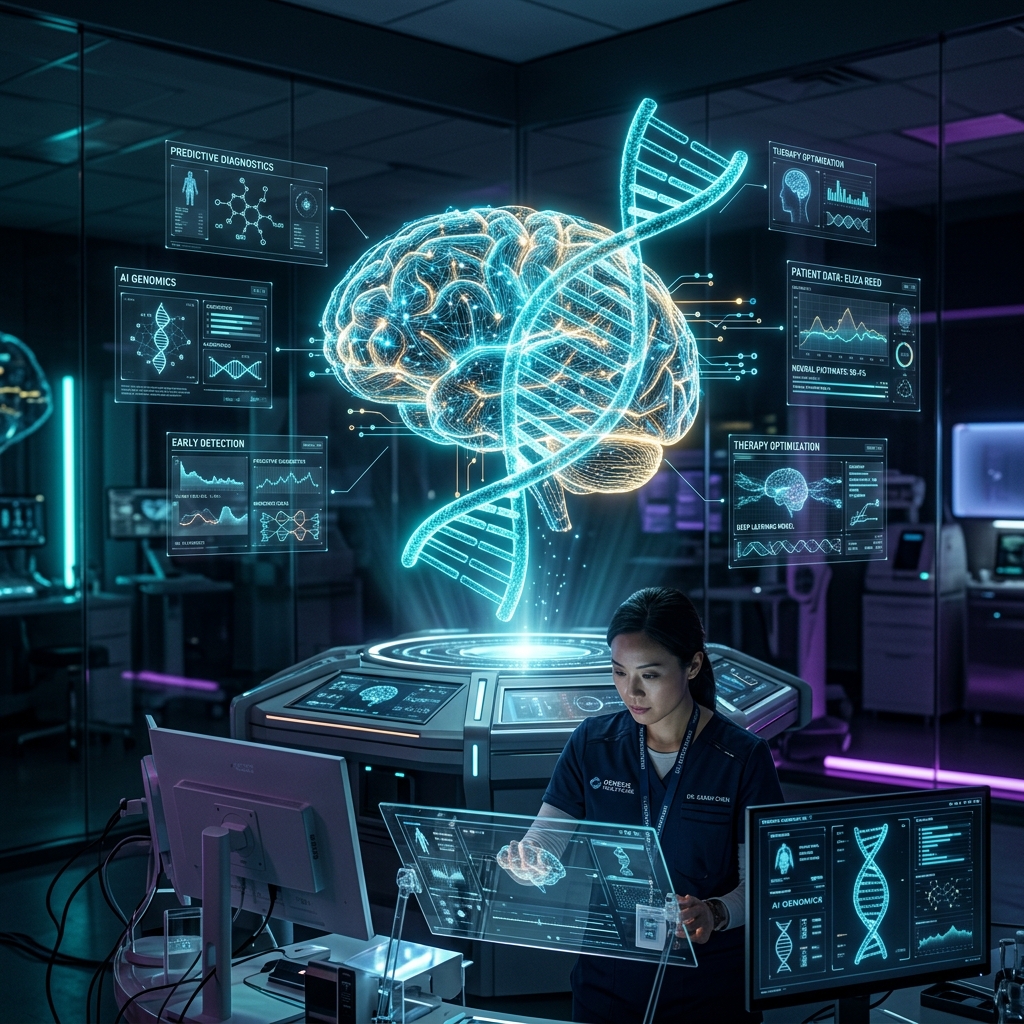
Artificial Intelligence seamlessly integrating into deep-tech medicine and diagnostics.
Introduction: The AI-Healthcare Revolution
Artificial intelligence (AI) in medicine uses technologies like machine learning, deep learning, natural language processing (NLP), computer vision, and robotics to improve diagnosis, streamline workflows, and enhance patient care. Coursera
While healthcare has historically been slow to embrace change, it's now adopting AI-powered tools at more than twice the rate of other sectors. In 2025, 22% of healthcare organizations integrated AI into operations—up from just 3% in 2023. By 2026, AI, blockchain, and emerging technologies are moving from experiments into core healthcare systems. NCBI
AI digital health solutions hold the potential to enhance efficiency, reduce costs, and improve health outcomes globally. WEF
1. AI-Powered Diagnostics & Disease Detection
How It Works
AI algorithms analyze medical images (X-rays, CT scans, MRI, brain scans) to detect diseases faster and more accurately than humans.
Research-Backed Evidence
| Application | AI Performance | Human Performance | Source |
|---|---|---|---|
| Bone fractures | AI spots more fractures than humans | Lower accuracy | WEF |
| Brain scans | AI can interpret brain scans with high precision | Requires expert radiologists | WEF |
| Disease detection | Leading use for AI in medicine today | Variable accuracy | Coursera |
| Medical diagnoses | Offers potential for more accurate diagnoses | Limited by human error | Coursera |
Real-World Impact
- AI can detect cancer, heart disease, and neurological conditions earlier, enabling proactive treatment.
- Reduces diagnostic errors, which affect millions of patients annually.
- Enables predictive analytics to prevent illnesses before they occur. xFactr
2. AI Scribes & Clinical Documentation
The 2026 Trend: AI Scribes Will Dominate
AI scribes are briefly going to dominate 2026. YouTube
How It Works
- Large language models (LLMs) adapted for clinical contexts.
- Healthcare-specific LLMs designed to support:
- Documentation (automating patient notes)
- Evidence synthesis (summarizing research)
- Decision support (clinical recommendations)
Why It Matters
- Reduces tedious administrative tasks that lead to healthcare burnout. Medtronic
- Frees up doctors to focus on patient care rather than paperwork.
- Improves accuracy of medical records.
3. Agentic AI & AI Agents in Healthcare
What Are AI Agents?
AI agents are autonomous systems that make decisions and execute tasks without constant human guidance.
2026 Transformation
As 2026 unfolds, healthcare organizations are embracing AI technology to an unprecedented degree across:
- Patient care
- Clinical workflows
- Drug discovery and development BCG
Impact
- AI's potential to improve patient outcomes, enhance efficiency, and accelerate innovation is redefining how healthcare creates value.
- AI agents will handle routine tasks like scheduling, medication reminders, and follow-up coordination.
4. Personalized Medicine & Treatment Plans
How AI Enables Personalization
AI analyzes vast amounts of patient data (genomics, lifestyle, medical history) to create customized treatment plans.
| Area | AI Application |
|---|---|
| Drug selection | Identifies most effective medications for individual patients. |
| Treatment dosing | Calculates optimal doses based on patient characteristics. |
| Predictive care | Predicts which patients are at risk for specific conditions. |
| Longevity research | Systems-level approaches integrating multiomics, digital biomarkers, metabolic profiling. |
5. AI + Telemedicine: Smarter Remote Care
Integration Trends for 2026
AI will integrate seamlessly with telemedicine, making remote care smarter and more efficient.
Key Features
- Home-based blood diagnostics: Standardized home kits enabling patients to collect blood samples outside clinics, with results integrated into telemedicine platforms.
- Digital patient navigators: Help individuals traverse the digitized healthcare system, improve access, and address digital literacy gaps.
- Medical concierge services: Enhanced membership-based care with longer consultations, proactive lifestyle support, and closer follow-ups.
6. Drug Discovery & Development Acceleration
AI dramatically accelerates the pace of drug development by predicting molecular interactions, identifying promising drug candidates, and optimizing clinical trial designs.
7. AI for Healthcare Operations & Efficiency
| Function | AI Impact |
|---|---|
| Clinical decision making | Improves accuracy with real-time data analysis. |
| Nonclinical decisions | Optimizes staffing and resource allocation. |
| Medical variability | Reduces inconsistencies in treatment. |
| Administrative tasks | Reduces volume of tedious tasks causing burnout. |
| Medication errors | Reduces errors through automated checks. |
| Fraud prevention | Identifies insurance fraud patterns. |
Key 2026 trend: ROI proof over promise—healthcare organizations are moving from experimentation to demonstrating measurable returns.
8. Blockchain + AI: Secure Health Data
Both blockchain and AI have already proven transformative in Healthcare and Life Sciences.
- Blockchain: Secure, distributed ledger for medical records
- AI: Analyzes encrypted data without compromising privacy
- Combined: Enables secure data sharing while maintaining patient confidentiality. By 2026, accelerated momentum in three key directions including blockchain-AI integration.
9. Org Readiness & AI-Human Collaboration
AI-human collaboration is becoming the standard—not replacing doctors, but augmenting their capabilities.
- ROI proof over promise: Focus on measurable returns, not just potential.
- Org readiness kicking up a notch: Healthcare organizations building AI capabilities.
- AI-human collaboration: Moving from generic assistance to healthcare-specific support.
10. Digital Biomarkers & Longevity Tech
Longevity research is refocusing toward systems-level approaches that integrate Multiomics (genomics, proteomics, metabolomics), Digital biomarkers (wearable data, continuous monitoring), Metabolic profiling, and Personalized prevention strategies.

AI driving universal health coverage, bridging the urban-rural divide in India's digital health infrastructure.
AI in Healthcare: Transforming Indian Healthcare & Delivering Universal Health & Wellness for All Citizens
Authentic, research-backed insights on how technology can bridge India's healthcare gaps and create a model for global health equity.
Executive Summary: India's Healthcare Crisis & AI Opportunity
India faces a massive healthcare challenge:
- 1.4 billion population with only 1.7 doctors per 1,000 people (WHO recommends 3:1).
- 66% prefer private facilities but 60% pay out-of-pocket, risking financial ruin from illness.
- Massive urban-rural divide: Rural areas have severely limited access to quality healthcare.
- 80,000+ primary health centers transformed into health and wellness centers, yet gaps remain.
Key Takeaways
- AI adoption is accelerating: 22% of healthcare organizations used AI in 2025 (vs. 3% in 2023).
- AI scribes will dominate 2026: Automating clinical documentation.
- Diagnostics improved: AI spots more bone fractures than humans.
- Shift to prevention: Predictive analytics prevent illnesses before they occur.
- Home-based care rising: Blood diagnostics kits integrate with telemedicine.
- Market expanding: AI healthcare market will grow rapidly.