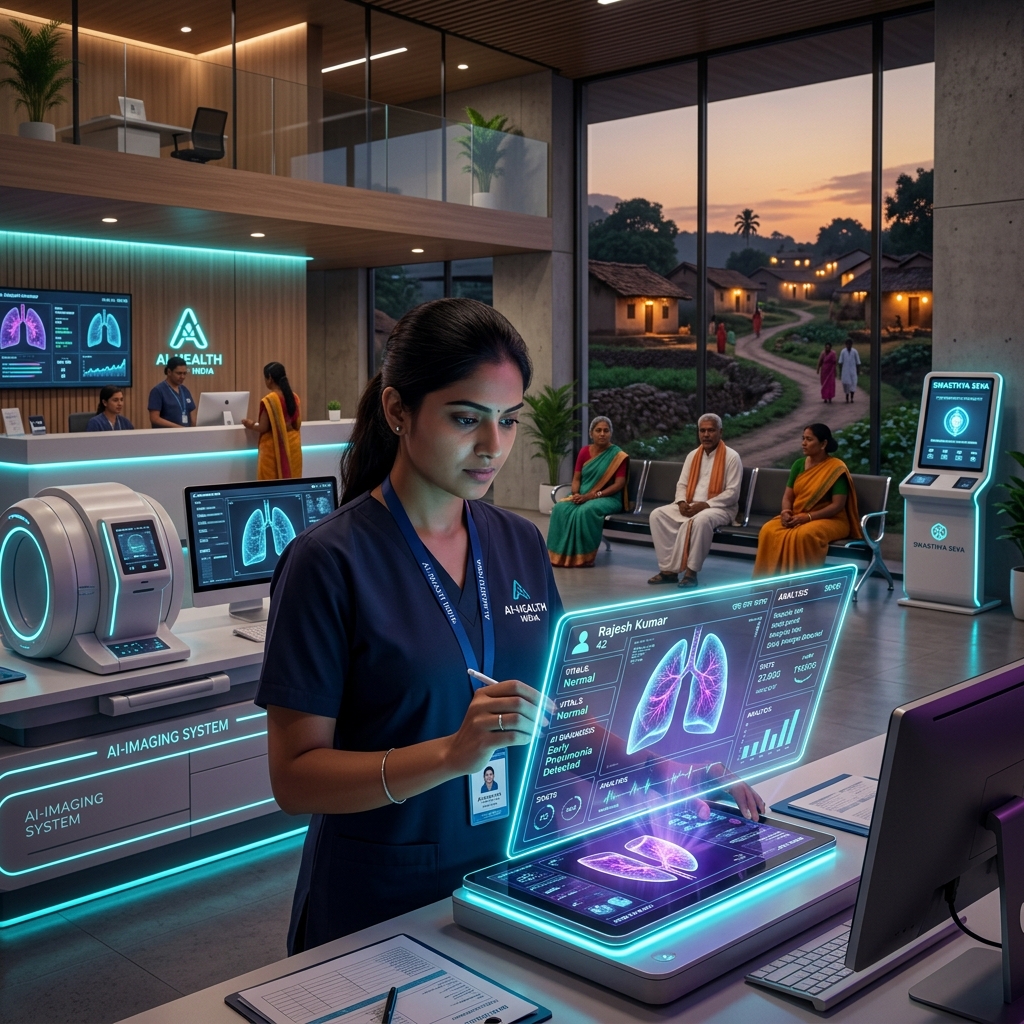
AI-powered primary health clinics enabling technician-led diagnostics in rural India.
Executive Summary: India's Healthcare Crisis & AI Opportunity
India faces a massive healthcare challenge:
- 1.4 billion population with only 1.7 doctors per 1,000 people (WHO recommends 3:1) NCBI
- 66% prefer private facilities but 60% pay out-of-pocket, risking financial ruin from illness.
- Massive urban-rural divide: Rural areas have severely limited access to quality healthcare.
- 80,000+ primary health centers transformed into health and wellness centers, yet gaps remain.
AI is the solution: India is transitioning from reactive problem-solving to proactive, inclusive innovation through AI, digital public infrastructure, and cross-sector collaboration.
Part 1: How Indian Healthcare Needs to Improve
Critical Challenges
| Challenge | Current Status | Impact |
|---|---|---|
| Doctor shortage | 1.7 doctors per 1,000 people | Millions lack access to care |
| Urban-rural gap | 66% prefer private facilities; rural areas underserved | Health disparities between communities |
| Out-of-pocket costs | 60% paid personally | Financial ruin from unexpected illness |
| Limited specialists | Most specialists in urban cities | Rural patients can't access expert care |
| Administrative burden | Manual processes in hospitals | Delayed care, inefficiency |
| Diagnostic delays | Long wait times for tests | Diseases progress untreated |
| Poor data integration | Fragmented health records | No continuity of care |
Part 2: How Technology Can Help All Categories of Indian Citizens
AI in Indian healthcare is moving from pilots to real-world deployment across diagnostics, telemedicine, critical care monitoring, and pharmaceutical R&D.
1. Rural & Remote Communities: Telemedicine + AI Diagnostics
- eSanjeevani Telemedicine: AI-enabled telemedicine provides broader access at scale, already serving millions of rural patients remotely.
- Digital Primary Care Clinics: Task-shifting from doctors to trained community workers using frugal innovation. Proven beneficial in West Bengal, Bihar, and Assam.
- Virtual-Physical Bridge Model: Virtual care is the default first step before escalating to in-person care.
2. Low-Income Families: Affordable AI Diagnostics + Government Schemes
- Fast, Cheap Screening: Faster screening for TB, cancer, and eye disease. AI diagnostics are more accurate and cheaper than traditional methods.
- Ayushman Bharat: Covers 100+ million poor and vulnerable families with digital tools helping manage claims.
3. Chronic Disease Patients: Predictive Analytics + Remote Monitoring
- Predicts which patients are at risk for complications and alerts doctors before emergencies occur.
- Home-based blood diagnostics via standardized home kits with results integrated into telemedicine.
Part 3: Case Studies of AI-Powered Diagnostic Tools in Indian Primary Care
India's primary care faces a critical diagnostic gap. AI-powered diagnostic tools are bridging this gap by enabling technician-led screenings, delivering results in minutes, and operating offline with 90-95% accuracy.
Case Study 1: Qure.ai's qER for Stroke Diagnosis
- Problem: Limited neurologists in Assam caused critical stroke treatment delays.
- Solution: AI tool for head CT scan analysis providing results in under 3 minutes with 95% accuracy.
- Impact: Replaces specialist dependency in rural hospitals, enabling faster stroke treatment.
Case Study 2: Qure.ai's qXR for Tuberculosis Detection
- Problem: Radiologists are concentrated in Tier-1 cities, hampering mass TB screening.
- Solution: CE-certified AI interprets chest X-rays in seconds, optimized for TB, pneumonia, and lung nodules in India.
- Impact: Enables technician-led TB screening in rural areas, expanding the National TB Elimination Program.
Case Study 3: Tricog Health's InstaECG & VCardia
- Problem: Primary health centers lack cardiologists for ECG interpretation.
- Solution: Combines AI with cloud-connected ECG machines. Data is sent to the cloud, AI analyzes, and medical experts verify within minutes.
Case Study 4: Forus Health's 3nethra for Diabetic Retinopathy
- Problem: Diabetic Retinopathy is a leading cause of blindness, but rural areas lack ophthalmologists.
- Solution: AI-integrated fundus cameras allow technicians to conduct screenings and instantly flag patients needing referral.
Case Study 5: Remidio's Smartphone-Based Fundus Imaging
- Problem: Remote health camps have unstable internet connectivity.
- Solution: Uses offline AI to detect DR via smartphone, perfect for remote health camps.
Case Study 6: Niramai's Thermalytix for Breast Cancer
- Problem: Social stigma and lack of rural mammography delay breast cancer detection.
- Solution: Non-invasive, radiation-free thermal imaging analyzed by ML to detect early-stage tumors.
Case Study 7: SigTuple's AI Platform for Pathology
- Problem: Clinics lack senior pathologists and manual microscopy is slow.
- Solution: Automates microscopy and digitizes blood smears and urine samples.
Case Study 8: Apollo Hospitals' AI Cardio Risk Tool
- Problem: Global standards like the Framingham Risk Score are less accurate for Indians.
- Solution: AI tool trained specifically on Indian population data and lifestyle factors, outperforming Framingham.
Comparison Table: AI Diagnostic Tools in Indian Primary Care
| Tool | Company | Disease | Speed | Setting |
|---|---|---|---|---|
| qER | Qure.ai | Stroke (head CT) | <3 min | Rural hospital |
| qXR | Qure.ai | TB, Pneumonia | Seconds | Rural clinic |
| InstaECG | Tricog | Cardiac (ECG) | Minutes | Primary center |
| 3nethra | Forus Health | Diabetic Retinopathy | Instant | Primary clinic |
| Thermalytix | Niramai | Breast Cancer | Minutes | Rural clinic |
| Cardio Risk Tool | Apollo | Heart disease | Instant | Primary care |
Conclusion: A Model for Global Health Equity
India's model of AI + digital public infrastructure + cross-sector collaboration can be replicated globally. By embracing technology-leapfrogging and frugal innovation, India is not just solving its own healthcare crisis, but creating a blueprint for the world to deliver Universal Health Coverage.
"Digital health has the potential to overcome barriers to affordable health care in India and across the world."