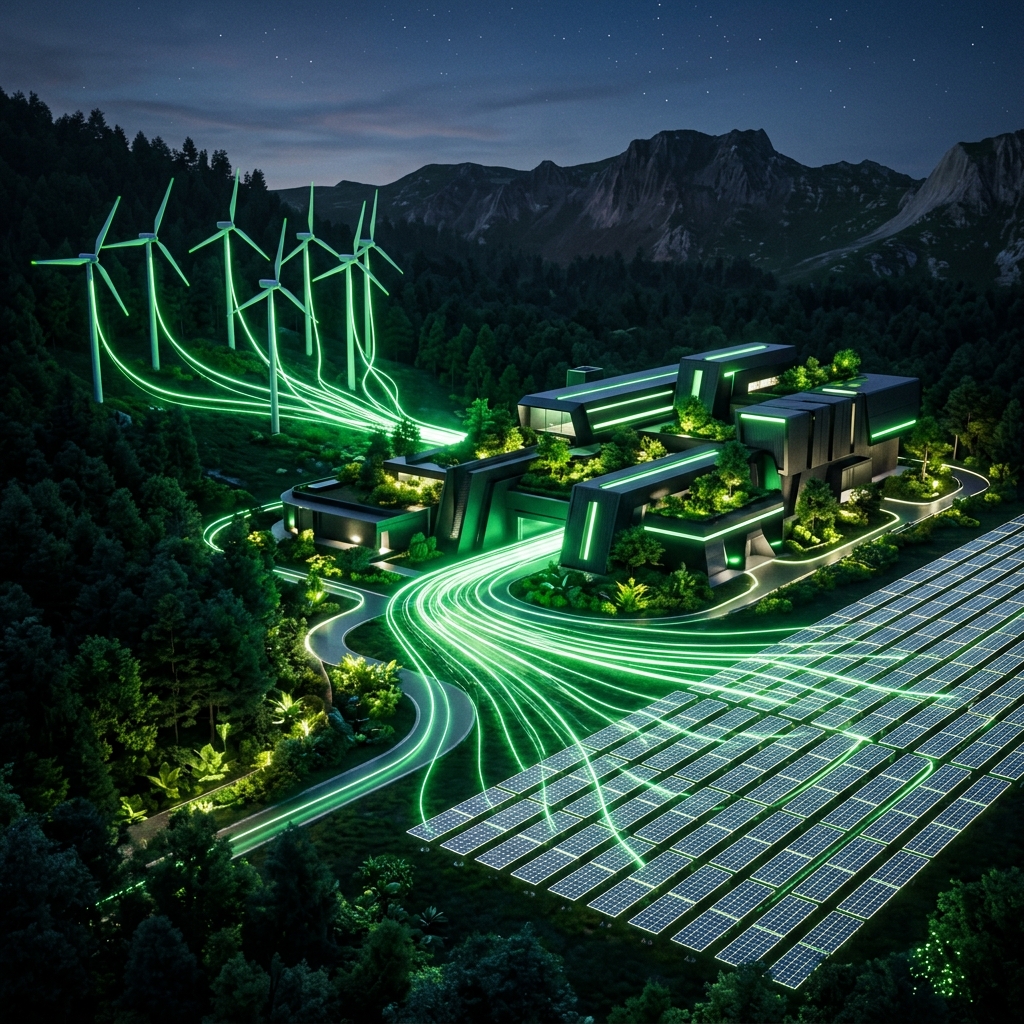
A futuristic data center integrating wind and solar energy grids for dynamic, carbon-aware cloud orchestration.
Sustainability only becomes scalable when it's profitable—and engineering is the lever that makes both happen. By treating carbon footprint tracking and energy mix optimization as core infrastructure (not buzzwords), we can reduce the impact of the digital economy while keeping margins intact.
Why care now?
- AI and cloud workloads are exploding: Global data-center power demand is projected to grow 2–3× by 2028, reaching 380–450 TWh—roughly 1.5% of total electricity use.
- Data centers already account for ~2% of global electricity today, and AI alone may consume 85–340 TWh by 2028.
- Responsible growth is not optional: Stakeholders expect measurable decarbonization, not rhetoric.
The Engineering Lever: Carbon + Energy as First‑Class Metrics
Sustainability must be profitable to be scalable. We focus on two levers that directly impact cost and emissions:
1. Carbon Footprint Tracking
- Instrument scope 2 emissions (purchased electricity) at the workload level using cloud carbon tooling (e.g., AWS Customer Carbon Footprint Tool) and integrate these into CI/CD dashboards.
- Add carbon budgets per service or sprint (e.g., gCO₂e/request). When a budget is exceeded, the pipeline gates production or triggers optimization. This makes carbon a queueing constraint, not a poster.
2. Energy Mix Optimization
- Use cloud carbon‑aware scheduling: run batch jobs in regions and times with lower renewable intensity (e.g., when solar/wind is abundant). Providers now offer carbon-aware regions and time windows.
- Prefer renewable‑heavy regions (e.g., AWS regions with high on-grid renewable share) and align peak compute to off-peak hours where price and emissions are lower. This often reduces both cost and gCO₂e/kWh.
Together, these levers turn emissions into operational decisions: if your model is too carbon-intensive, you refactor it, compress it, or schedule it differently. That's how sustainability becomes profitable.
The Sustainability Stack: Efficiency, Lifecycle, Transparency
This is the stack we build on—it's not a checklist; it's an architectural pattern.

The three layered pillars of the Sustainability Stack: software efficiency, hardware lifecycle, and decentralized transaction transparency.
Efficiency: Lower Compute per Request = Lower Energy Demand
Energy demand is driven mostly by how much computation you run. Efficiency wins here:
- Model compression & quantization: Smaller models (or quantized versions) often deliver 30–50% energy savings for inference with minimal accuracy loss.
- Cache‑first architectures: Use response caching, semantic caches, and key-value caches to avoid repeated LLM calls. Caching can cut AI inference costs by 30–50% and directly reduces energy.
- Serverless & autoscaling: Scale to zero when idle, and use burst capacity only when needed. This reduces baseline energy waste.
- Region‑aware routing: Route requests to lower-carbon regions dynamically based on time-of-day renewable intensity.
Efficiency is the fastest ROI: it reduces emissions and costs in the same release.
Lifecycle: Hardware Longevity + Circular Economy
The sustainability stack doesn't stop at software:
- Design for longevity: Choose hardware with upgrade paths, extend warranty life, and avoid ephemeral devices that need frequent replacement.
- Circular economy principles: Reuse, refurbish, and recycle components. E-waste reached 62 million tonnes in 2022, with only 22% formally recycled—so every cycle closed matters.
- Right‑size infrastructure: Prefer managed services and pooled resources over bare-metal over-provisioning; this reduces stranded capacity and waste.
Lifecycle engineering reduces the total material footprint while keeping systems reliable.
Transparency: Verifiable Proof of Green Energy On‑Chain
Trust requires proof:
- On‑chain energy receipts: Publish verifiable "green energy receipts" where workloads are proven to have run during renewable peaks or in renewable-rich regions. These receipts can be audited by stakeholders.
- Transparency dashboards: Integrate carbon and energy telemetry into public dashboards (per service, region, and time window).
- Audit‑ready logs: Record every build, deploy, and run with carbon tags so compliance audits can be auto-generated.
Transparency is the foundation for credible claims and regulatory compliance.
What This Means in Practice: From Runs to Profits
The implementation loop follows a continuous cycle:
- Measure: Instrument carbon per request using cloud tooling; add telemetry to your CI/CD.
- Budget: Set carbon budgets per service/sprint; gate production on exceedance.
- Optimize: Compress models, cache responses, and schedule batch jobs to renewable peaks.
- Verify: Publish on-chain energy receipts and transparency dashboards for stakeholders.
- Iterate: Treat efficiency as a continuous loop—improve, measure, budget, re-optimize.
This loop turns sustainability from a cost center into a profit driver: lower emissions, lower costs, and audit-ready compliance.
Frequently Asked Questions
Can one developer make a difference?
Yes. A single developer can reduce emissions significantly by: quantizing models (30-50% energy savings), adding caching to avoid repeated LLM calls (30-50% cost and energy reduction), and scheduling batch jobs to low-carbon regions and time windows.
What is sustainable logistics?
Sustainable logistics is planning and executing shipments to minimize emissions while maintaining reliability and cost-effectiveness. Key tactics include route optimization (such as in Electra Wheeler), load right-sizing, fleet electrification, and carbon-aware network scheduling.
How do you track carbon footprints?
Use cloud provider carbon tools for scope 2 emissions, integrate carbon telemetry in code (gCO₂e/request), set carbon budgets to gate production pipelines, and publish verifiable on-chain energy receipts for audits.
Engineering is the lever we use to move the world toward sustainability. By making carbon footprint tracking and energy mix optimization first-class concerns, we can reduce the digital economy's impact while keeping sustainability profitable—and scalable.
- Data centers represent ~2% of global electricity today; AI drives 3× growth by 2028.
- E-waste is at 62M tonnes globally with only 22% recycled.
- Efficiency methods (quantization, caching) cut inference cost and energy by 30-50%.
Share this article
Spread awareness about carbon‑aware software systems and green cloud architecture.
Written by Govind Mehta
AI Systems Engineer · Startup Founder · Exploring the future of technology