Imagine a brilliant student in a small town who spends three years locked in a room, memorizing facts for a competitive exam that only 1% pass. By the end, they either win the lottery or lose the best years of their youth with no real-world skills to show for it.
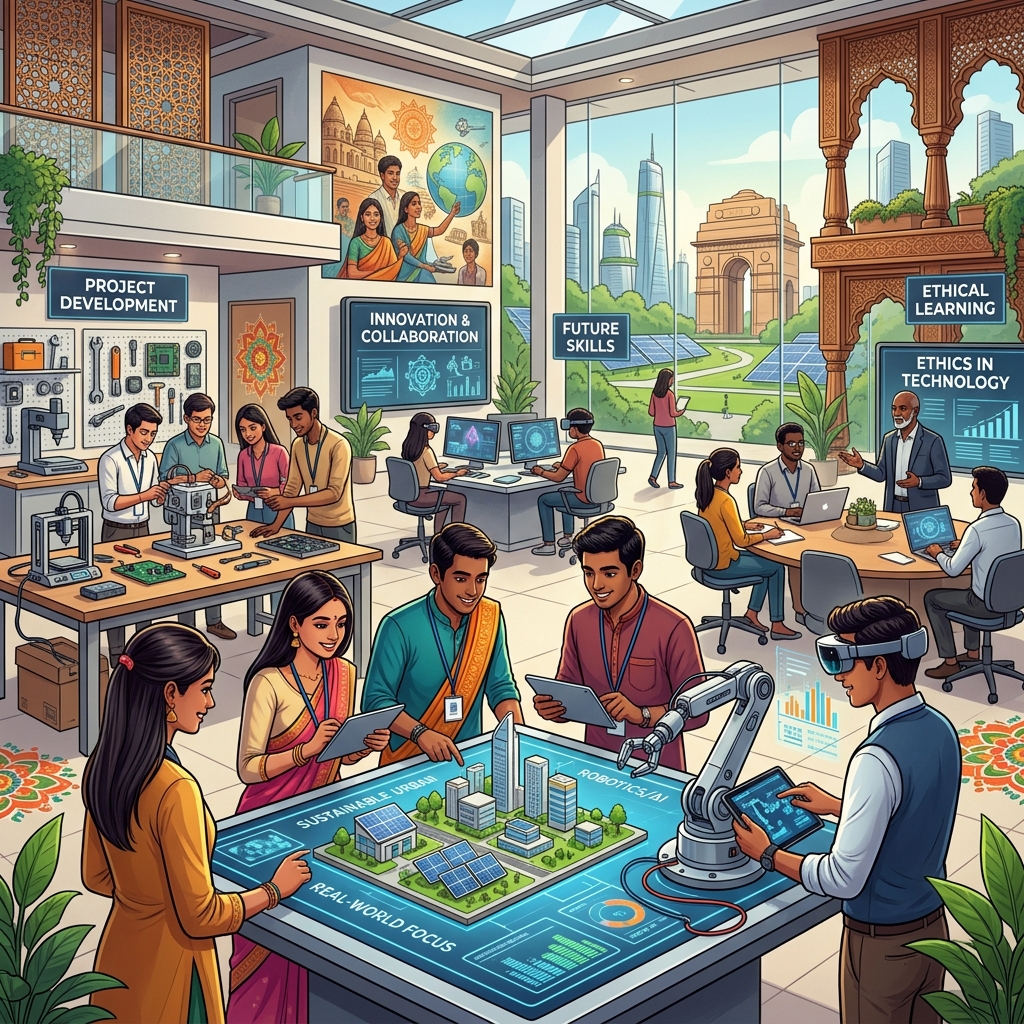
Now, ask yourself: What if instead of a sorting machine, our education system was an infrastructure for building real capabilities? What if we stopped training students to just clear tests and started preparing them to build the future? How powerful would India become if education was truly free, fair, and fundamentally skill-based?
India can move to a free, fair, skill-based education system that builds both moral character and economic power if it treats education as a public infrastructure for distributed power, not just as a race for scarce jobs. This document serves as a robust, policy-level framework designed to operationalize this transformation.
For decades, the Indian education system has behaved like a giant sorting machine: students spend some of the best years of their lives preparing for a narrow set of competitive exams, while real learning, skills, and ethics often stay secondary. A meritocratic exam system is necessary—but when test preparation becomes the main purpose of education, the country loses innovation, mental health, and productive years of youth.
If India wants to become truly powerful—collectively and individually—it needs an education system that is free, skill-based, ethical, and genuinely linked to the country’s economic and social future. It also needs to ensure that power is distributed through millions of capable citizens, not concentrated in a small elite of “exam winners.”
1. The Problem: Exams without Outcomes
Multiple official analyses already recognise that India’s education and skilling system is misaligned with employment and real learning outcomes. A recent NITI Aayog report explicitly found that the country faces a severe employability gap: degrees and exam success do not consistently translate into job-ready skills or productivity. It recommends moving “from credentials to learning outcomes” and calls for a National Job Skilling Policy that integrates education and employment. [Source: NITI Aayog]
At the same time, the National Education Policy (NEP) 2020 acknowledges that the older system was too rigid, content-focused, and exam-centric, and proposes a paradigm shift toward competency-based education, flexible degrees, and embedded skill development. [Source: NEP 2020 Framework]
The Core Systemic Failures
- The Exam Trap: Millions of students are trapped in intense, multi-year competition for a statistically insignificant number of seats and government jobs.
- Skill Deficit: Large swathes of the curriculum fail to translate into actionable skills that modern employers actually need.
- Youth Underemployment: Unemployment and underemployment remain disproportionately high despite rapidly rising educational attainment across the demographic. [Source: PIB]
This is not only an economic problem. It is a moral one. When young people spend years in exam coaching instead of learning, creating, or serving, the country loses both practical skill and civic character.
2. The Vision: Free, Fair, Skill-Based Education
A realistic future for India’s education system must rest on five unshakeable pillars. Many of these elements already exist in policy documents; the challenge lies in scale, design, and uncompromising intent.
Fundamentally Free Access
Free or truly affordable access from early childhood to at least one level of higher education, ensuring no student is excluded for financial reasons.
Embedded Skill Learning
Skill-based learning integrated natively into mainstream education, not siloed as an inferior “vocational sideline.”
Reformed, Fair Gateways
Fair, transparent, and limited competitive exams focused strictly on assessing real applied competence rather than rote memorisation.
Ethics at the Centre
Honesty, morality, and ethics enforced as core measurable outcomes, especially for pathways into positions of public power and governance.
Distributed Capability
Distributed power through widespread education, so millions of citizens can participate in local governance and innovation, breaking elite concentration.
3. Benchmarking Global Models
India does not need to blindly copy any country, but it is critical to benchmark against nations that have tightly integrated education, skills, and employment into a cohesive engine.
| Global Region | Core Strengths & Strategic Focus |
|---|---|
| Germany, Austria & Switzerland | Operate robust dual vocational/apprenticeship systems where classroom learning is tied directly to corporate shop floors. Vocational tracks are highly respected and well-funded. [OECD Data] |
| Finland & Denmark | Emphasize broad competence, absolute equity, world-class teacher quality, and student well-being. They actively minimize high-stakes rote examinations. |
| Singapore & Netherlands | Combine rigorous academic standards with clear, industry-backed pathways from secondary education directly into specific, high-growth sectors. |
The Common Denominator: These systems succeed because vocational and technical education is treated as a first-class path—not a "fallback." There is deep collaboration between schools and employers, driven by strict national qualifications frameworks. India already possesses elements of this (e.g., NSQF-aligned courses, PMKVY, DDU-GKY). The mandate now is to move them from the periphery to the center. [Lok Sabha Report]
4. Policy Pillar 1: Make Core Education Functionally Free
To unlock latent talent and ethics across a demographic of 1.4 billion, core education must be effectively free at the point of use. Public investment must urgently pivot toward quality and unrestricted access.
- Guaranteed Access: Secure free access to early childhood and primary/secondary school education, backed by sustained state/central funding formulas, eliminating reliance on short-term schemes. [NITI Aayog]
- Financial Firewalls: Radically expand financial support matrices (direct scholarships, income-linked support, zero-interest credit) for higher education to guarantee that zero capable students are blocked by family income limitations.
- Asynchronous Progression: Leverage infrastructure like the Academic Bank of Credits (ABC) to allow students to pause, work, care for family, and seamlessly resume education without losing their accrued progress.
5. Policy Pillar 2: Embed Skills Natively
NEP 2020 mandates that 50% of higher-education students will have vocational training by 2030 TARGET 2030. To translate this ambitious policy into reality, the curriculum must be rewritten to treat skills as core competencies.
- Class 9 Integration: Mandate the integration of vocational and skill courses from Class 9 onwards, aligned explicitly with local economic opportunities, treating them as equal to traditional academic subjects. [GRAAM]
- Universal Soft Skills: Embed employability skills (problem-solving, ethical reasoning, digital literacy, cross-functional teamwork) into every degree program. NEP 2020 requires this; implementation is the missing link.
- Hyper-Local Alignment: Synchronize school curricula with district-level job diagnostics. Utilize tools like the "Jobs at Your Doorstep" framework (seen in Kerala and Maharashtra) to map local skills gaps to classroom instruction. [PIB]
- Institution Upgrades: Modernize ITIs, polytechnics, and training hubs to global standards, heavily incentivizing private companies to co-invest in workforce training pipelines. [NDTV]
6. Policy Pillar 3: Reform Competitive Exams (DIGI-EXAM)
Exams cannot be abolished in a high-population nation—they are a principled mechanism to allocate scarce resources. However, they must be transformed into fair gateways rather than lifelong traps.
- Systemic Integrity: Deploy secure digital infrastructure, unbreakable audit trails, and independent oversight. Paper leaks and marking irregularities must be prosecuted as critical national infrastructure failures.
- De-risk High Stakes: Reduce the psychological and economic concentration on single, high-stakes exams by expanding the base of high-quality institutions and offering diverse, respected alternate pathways.
- Test Competence, Not Recall: Redesign assessments to test applied competence, critical thinking, and ethical decision-making, moving away from speed-and-memory metrics.
- Continuous Pathways: Establish "try-and-return" pathways where exam preparation can be interspersed with real-world work, preventing youth from dropping out of the productive economy for years at a time.
7. Policy Pillar 4: Ethics at the Centre of Public Power
If education is the pipeline to public power (civil services, judiciary, regulatory bodies), it must explicitly engineer ethical fortitude, not merely filter for analytical intelligence.
- Mandatory Civic Ethics: Enforce rigorous ethics and public service modules for all public leadership tracks, covering constitutional justice, equity, and anti-corruption frameworks.
- Integrity Assessments: Revolutionize civil service recruitment to actively assess integrity, empathy, and public-mindedness alongside subject matter expertise.
- Continuous Calibration: Implement continuous ethics training for public officials tied directly to career progression, ensuring character development is an ongoing professional requirement.
- Community Immersion: Mandate community-based learning projects (addressing health, environment, local governance) to build grounded empathy and operational responsibility in future leaders.
8. Policy Pillar 5: Distribute Capability, Decentralize Power
A fair education system manufactures capable citizens who can think, organize, and govern locally. It is the ultimate tool for decentralization.
- Local Governance Literacy: Educate citizens on civic rights, local body administration, municipal budgeting, and public accountability starting in secondary school.
- Venture Incubation: Encourage cooperative models and entrepreneurship to equip students to build local institutions and social ventures, breaking the singular obsession with corporate or government employment.
- Data Transparency: Democratize data on regional jobs, skills demands, and educational outcomes, empowering communities to hold institutions accountable.
- Lifelong Reskilling: Institutionalize flexible learning pathways via credit banks and digital open universities, removing the monopoly of gatekeeping institutions over adult education. [World Bank]
9. The Macroeconomic Impact: From Exam Time to Growth Time
Reorienting millions of youth-hours from rote exam obsession toward actionable skill building yields immediate, measurable macroeconomic benefits:
Surging Employability
Aligning curricula with outcome-based skilling directly closes India's widening employability gap, making graduates instantly productive.
Sector-Specific Growth
Mapping school-level training to district-level diagnostics channels youth into high-opportunity roles exactly where capital is flowing.
Innovation Multiplier
Freeing time from exam-drills allows for experimentation, naturally producing more startups, small businesses, and localized solutions.
10. The Implementation Roadmap
To move from vision to statutory policy, India must execute a staged, uncompromising roadmap:
Immediate Horizon (1–3 Years)
Focus: Agility & Transparency
- Fully enforce NEP 2020’s flexibility, Academic Bank of Credits, and vocational integration in vanguard pilot states.
- Publish radically transparent public data on skills gaps, employment outcomes, and exam integrity metrics.
- Launch foundational ethics and civic modules across all secondary schools and universities.
Medium-Term Horizon (3–7 Years)
Focus: Scale & Structural Reform
- Scale integrated skill-based education nationwide, strictly governed by district job diagnostics and sectoral skill councils.
- Redesign the architecture of major competitive exams to test applied competence and ethical reasoning.
- Aggressively upgrade ITIs, polytechnics, and teacher training institutions via strict outcome-based funding models.
Long-Term Horizon (7–20 Years)
Focus: Global Dominance & Culture Shift
- Achieve the NEP target of 50%+ higher-education students possessing certified vocational or deep-tech skill training.
- Capture the 10% global services market share goal referenced by NITI Aayog’s skill division. [Reference]
- Embed continuous reskilling and ethical education as an unalterable cultural norm across public services and industry.
11. Short-Term Actions: Tech, Exams, and EdTech Execution
NEP 2020 is designed as a multi-decade policy. However, we cannot wait 15 years to rescue the current generation of students. We require fast, focused, technology-backed decisions that deploy in the next 36 months to secure exams and unlock digital education—without creating new vectors for corruption.
11.1 Deploy "DIGI-EXAM" to Secure Testing Infrastructure
A panel led by former ISRO chief R. Radhakrishnan has proposed a DIGI-EXAM framework inspired by the highly successful DIGI-YATRA. This includes Aadhaar-based authentication, biometric verification, AI-driven impersonation analytics, and a phased transition to secure Computer-Based Testing (CBT) for apex exams like NEET-UG. [Edu-Test Report]
Immediate Benefits: Eradicates paper leaks, enables adaptive multi-session testing (reducing single-day high-stakes pressure), and mathematically standardizes security protocols across all geographical testing centers.
11.2 Establish Technology as Public Infrastructure
Technology must not be limited to isolated pilot schemes; it must become a foundational public utility managed by the proposed National Education Technology Forum (NETF). [Extramarks Analysis]
- Deploy free/low-cost digital content in all Indian languages via DIKSHA and PM eVidya.
- Push localized skill courses mapped directly to district diagnostics via mobile applications.
- Provide robust remote analytics and training tools to support educators transitioning to competency-based methods.
11.3 Demolish Policy Barriers for Honest EdTech
To harness responsible private EdTech without compromising equity, India must pivot to outcome-based contracts. Government must fund platforms based strictly on verified improvements in student skills, not vanity metrics like app installs or video views. We need transparent accreditation frameworks and Open APIs to seamlessly integrate high-quality private content into public platforms like DIKSHA while retaining absolute state oversight.
11.4 Enforce Draconian Anti-Corruption Safeguards
Integrating private and social entities is necessary for speed, but requires non-negotiable safeguards. This means radically transparent tender processes for exam-tech procurement, rigorous independent auditing of algorithms and security protocols (including bias checks), and severe conflict-of-interest regulations for public officials engaging with EdTech contractors.
Q&A (Policy Clarifications)
Why not abolish competitive exams entirely?
How does DIGI-EXAM physically secure the process?
What is the economic argument for "Embedded Skills"?
12. Executive Conclusion
India’s education reform cannot wait for distant timelines to mature. While NEP 2020 provides an exceptional long-term compass, the current generation of students requires immediate, visible intervention: unbreakable exam security, liberation from the rote coaching-industry complex, and ubiquitous access to skill-based digital learning.
The fastest mechanism to bridge this implementation gap is leveraging technology as a public utility, integrating honest private sector capabilities under draconian public oversight, and modernizing the structural architecture of Indian education. If we can successfully re-engineer this system from an anxiety-inducing sorting machine into an infrastructure for distributed capability, education will become the ultimate engine of India's macroeconomic growth, social fairness, and unassailable national strength.