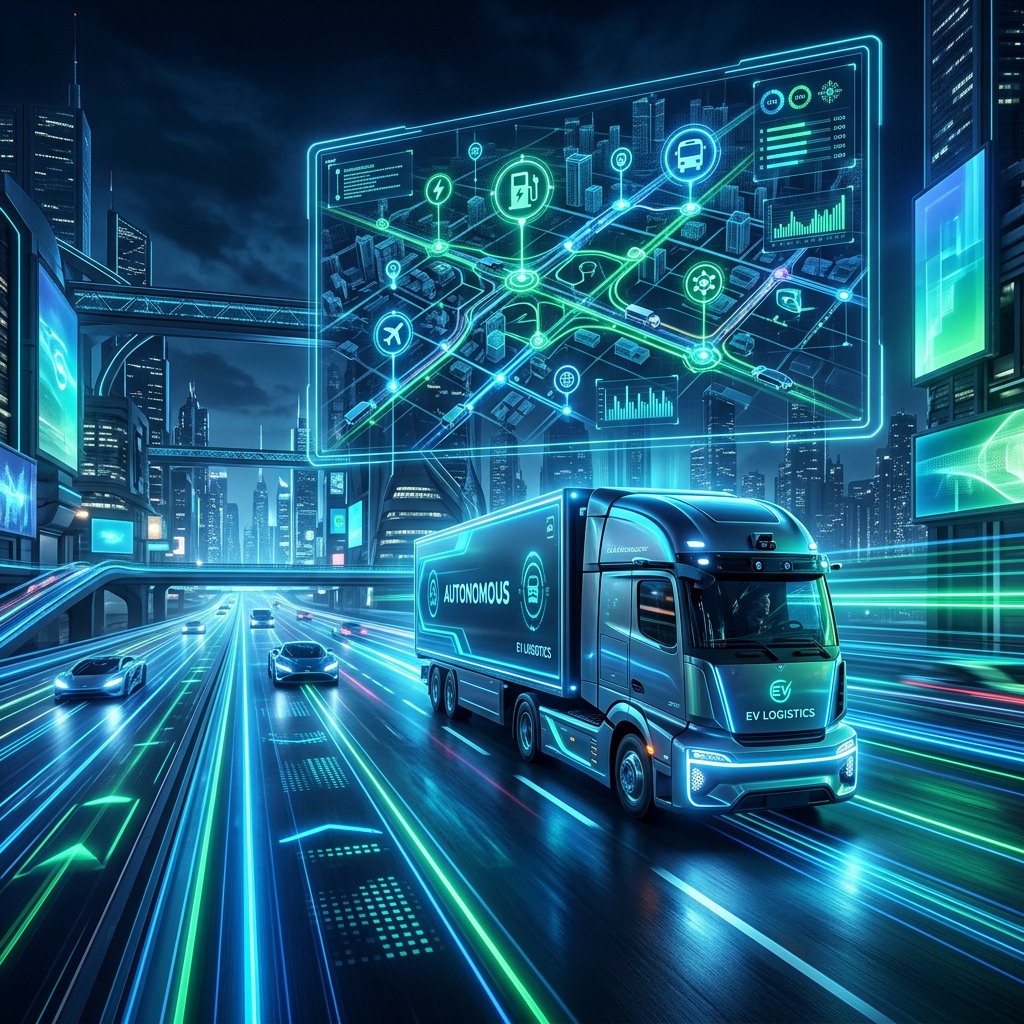
The routing problem has fundamentally changed. Ten years ago, the challenge was finding the shortest path between Point A and Point B while avoiding traffic. Today, with the rapid electrification of commercial fleets, routing is no longer just a geometry problem — it is an energy management and predictive intelligence problem.
In 2026, you cannot effectively route a fleet of Electric Vehicles (EVs) using standard navigation paradigms. An EV router must account for dynamic payload weight, gradient elevation, battery degradation, ambient temperature, and real-time charging station availability. A miscalculation doesn't just mean a late delivery; it means a stranded 10-ton vehicle on a highway.
This is where the intersection of Google Maps Platform APIs and Agentic AI is revolutionizing the industry. In this technical deep-dive, we will explore how modern route optimization software is evolving and how we are implementing these exact architectures at Dozert.AI to transform global EV logistics.
1. The Geospatial Backbone vs. The Intelligence Layer
While mapping platforms like Google Maps provide a robust geospatial backbone for consumer navigation, enterprise EV logistics require a completely different approach. You cannot simply plug a routing API into an app and expect it to handle the mathematical complexities of an electric fleet.
Standard APIs return distance and traffic. But EV routing requires predicting the future. We must answer: "If this truck drives 400km over a 3% gradient with a 5-ton payload at 35°C ambient temperature, what will the State of Charge (SOC) be when it arrives?"
This is why leading platforms are moving away from relying entirely on off-the-shelf APIs. Instead, they are building proprietary foundation models specifically trained for energy prediction, dynamic route optimization, and autonomous decision-making.
A map is just a canvas. To solve EV logistics at scale, you need an intelligence layer that sits above the map. You need AI Agents that actually understand the vehicle.
2. Agentic AI: From Reactive Planners to Autonomous Dispatchers
Traditional route optimization software is reactive. It calculates a static route, assigns it to a driver, and only recalculates if the driver misses a turn. Agentic AI changes the paradigm. Instead of static algorithms, we deploy autonomous software agents that actively monitor and manage the fleet in real-time.
Evaluates 10,000+ potential delivery permutations per minute. Automatically reassigns tasks if an EV consumes more energy than predicted due to headwinds.
Interfaces with grid APIs. If a designated charging hub is experiencing a local brownout or price surge, this agent reroutes the vehicle to an alternative hub mid-transit.
A synchronized virtual replica of the fleet. Agents run continuous Monte Carlo simulations in the twin to predict the probability of mission failure before it happens in reality.
3. How We Build This at Dozert.AI
At Dozert.AI, we realized early on that we could not rely on generic mapping APIs. We are building a mobile-first intelligent platform for India's EV owners and fleet operators, powered by our own proprietary foundation models for energy prediction, route optimization, and charging station indexing.
Proprietary Predictive Logistics
We have engineered an end-to-end ecosystem designed specifically for the complexities of the Indian EV landscape:
- Proprietary Charger Graph: We maintain a dynamic, real-time database of over 26,000+ EV charging stations across India. Our models constantly filter this graph based on location, power output, and live vehicle compatibility.
- Deep SOC Trip Planning: We built our own route calculation engine. A user inputs their source, destination, specific vehicle model, and starting battery percentage. Our system computes the precise range, identifies the mathematical optimum for charging stops, and outputs a live State of Charge (SOC) summary, complete with ETA and charging cost projections.
- Meet Dozi (Proprietary LLM): Standard UI is dead. We built Dozi, an embedded conversational AI assistant powered by our own decision-making LLM. Dozi understands the context of the journey and chats natively in English, Hindi, and Hinglish to adjust routes dynamically based on driver requests (e.g., "Switch to the cheapest charging stops").
- Agentic Trip Coach: Dozi doesn't just wait for commands. During active trips, it functions as a proactive Trip Coach. It monitors the vehicle's telemetry and autonomously alerts the driver when it's time to charge, calculates cost estimates on the fly, and suggests alternative stations if the current route becomes sub-optimal.
4. Solving the Big Problems: Societal and Economic Impact
We are not just building software for the sake of optimization; we are engineering solutions to some of the most critical bottlenecks in the global transition to sustainable energy. The lack of reliable charging infrastructure and unpredictable energy consumption are the primary reasons fleet operators hesitate to transition to EVs. By solving the predictability problem, we accelerate EV adoption on a macroeconomic scale.
Technically speaking, our architecture reduces the complexity of NP-hard routing problems (like the Vehicle Routing Problem with Time Windows and Energy Constraints) by utilizing a hybrid approach: fast heuristic approximations powered by our LLM, combined with fine-tuned Graph Neural Networks (GNNs) for final route selection. This means we can compute deterministic solutions for massive fleets in seconds rather than hours.
When you deploy Agentic AI and this deep EV routing software, the real-world impact is staggering. Moving from human-assisted dispatch to autonomous agentic dispatch yields massive dividends:
22% Reduction in Energy
Through gradient and thermal-aware route selection. Less energy wasted directly correlates to fewer grid spikes during peak hours.
Zero 'Range Anxiety'
Elimination of stranded vehicles. By treating the route as a dynamic, self-healing graph, we ensure drivers and logistics companies trust the EV ecosystem.
40% Less Idle Time
Optimized charging schedules that perfectly align with driver break mandates, solving the massive logistics downtime problem.
Infrastructure Mapping
By actively monitoring 26,000+ stations, our agents identify "charging deserts," generating data that influences national infrastructure planning.
The Road Ahead
The electrification of global logistics is not a hardware problem anymore; we have the batteries, and we have the trucks. It is a software orchestration problem.
By building proprietary foundation models and deploying autonomous decision-making capabilities through Agentic AI, platforms like Dozert.AI are laying down the digital neural network for the future of transportation. We aren't just predicting the optimal path; we are engineering systems that adapt, learn, and fundamentally solve the bottlenecks preventing a fully sustainable, electric future.
Written by Govind Mehta
AI Systems Engineer · Founder of Dozert.AI · Building Intelligent Infrastructure