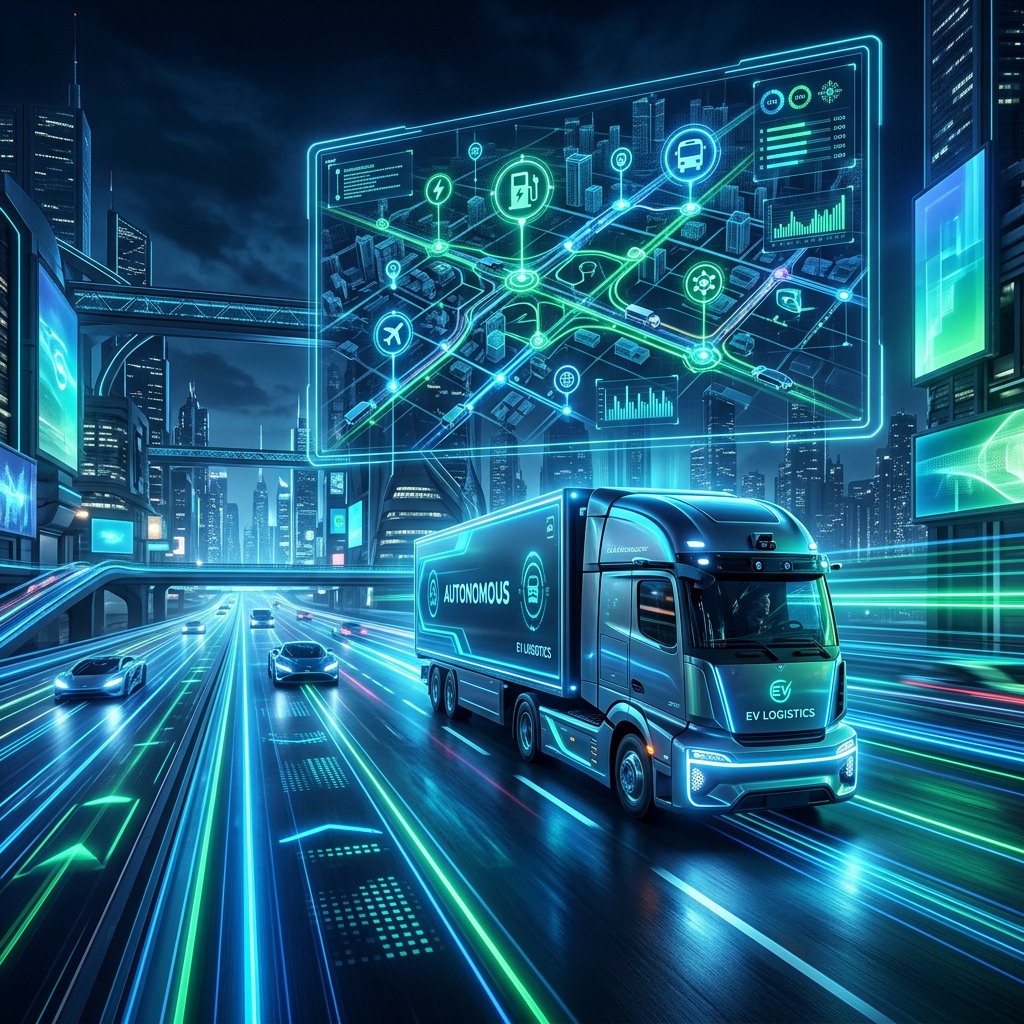
The routing problem has fundamentally changed. Ten years ago, the challenge was finding the shortest path between Point A and Point B while avoiding traffic. Today, with the rapid electrification of commercial fleets, routing is no longer just a geometry problem — it is an energy management and predictive intelligence problem.
In 2026, you cannot effectively route a fleet of Electric Vehicles (EVs) using standard navigation paradigms. An EV router must account for dynamic payload weight, gradient elevation, battery degradation, ambient temperature, and real-time charging station availability. A miscalculation doesn't just mean a late delivery; it means a stranded 10-ton vehicle on a highway.
This is where the intersection of Google Maps Platform APIs and Agentic AI is revolutionizing the industry. In this technical deep-dive, we will explore how modern route optimization software is evolving and how we are implementing these exact architectures at Dozert.AI to transform global EV logistics.
1. The Google Maps Routing API Evolution
Google Maps has quietly transitioned from a consumer navigation tool into enterprise-grade logistics infrastructure. The latest iterations of the Routes API and Maps Agentic UI Toolkit have introduced features specifically designed for the EV era.
Google's APIs now allow developers to pass specific vehicle telemetry—such as engine type, battery capacity, current charge level, and vehicle weight. The routing engine returns a path optimized not just for time, but for energy consumption (Eco-friendly routing).
Crucially, the API integrates live charging station data, automatically inserting optimal charging waypoints into long-haul routes based on plug type compatibility and predicted station congestion at the estimated time of arrival (ETA).
However, an API is just a data source. To solve enterprise logistics at scale, you need an intelligence layer sitting above the map. You need AI Agents.
2. Agentic AI: From Reactive Planners to Autonomous Dispatchers
Traditional route optimization software is reactive. It calculates a static route, assigns it to a driver, and only recalculates if the driver misses a turn. Agentic AI changes the paradigm. Instead of static algorithms, we deploy autonomous software agents that actively monitor and manage the fleet in real-time.
Evaluates 10,000+ potential delivery permutations per minute. Automatically reassigns tasks if an EV consumes more energy than predicted due to headwinds.
Interfaces with grid APIs. If a designated charging hub is experiencing a local brownout or price surge, this agent reroutes the vehicle to an alternative hub mid-transit.
A synchronized virtual replica of the fleet. Agents run continuous Monte Carlo simulations in the twin to predict the probability of mission failure before it happens in reality.
3. How We Build This at Dozert.AI
At Dozert.AI, we are building the orchestration layer that sits between the raw geospatial data of Google Maps and the complex operational realities of enterprise EV fleets. We treat route optimization not as a math equation, but as a dynamic multi-agent system.
Predictive Logistics Infrastructure
Here is how our pipeline transforms a standard routing problem into an intelligent logistics solution:
- Contextual Ingestion: We don't just pull Google Maps traffic data. Our ingestion pipeline pulls weather data (affecting battery thermals), payload weight sensor data, and historical driver efficiency metrics.
- LLM-Powered Edge Cases: We use Large Language Models (LLMs) to parse unstructured data that traditional routers miss. For example, reading local municipal tweets about unexpected road closures or port strikes, and instantly converting that text into geographic polygons to avoid.
- Multi-Objective Agent Optimization: Our proprietary orchestration engine deploys AI agents that negotiate with each other. The 'Delivery Agent' wants the fastest route. The 'Battery Agent' wants the most energy-efficient route. They use Reinforcement Learning (RL) to find the absolute mathematical optimum that satisfies enterprise SLAs without degrading battery health.
- Self-Healing Routes: If an EV charger goes offline while a truck is 50 miles away, our agentic system intercepts the telemetry, calculates the energy delta, books a bay at an alternative charging provider, and updates the driver's UI via the Google Maps SDK — completely autonomously.
4. The Impact on Transportation and Logistics
When you deploy Agentic AI and advanced EV routing software, the ROI is staggering. At Dozert.AI, we observe that moving from human-assisted dispatch to autonomous agentic dispatch yields:
22% Reduction
In total energy expenditure through gradient and thermal-aware route selection.
Zero 'Range Anxiety'
Elimination of stranded vehicles due to predictive failure modeling and self-healing routes.
40% Less Idle Time
Optimized charging schedules that perfectly align with driver break mandates.
Scalability
A single human dispatcher can oversee 500+ vehicles, as agents handle the micro-decisions.
The Road Ahead
The electrification of global logistics is not a hardware problem anymore; we have the batteries, and we have the trucks. It is a software orchestration problem.
By combining the unparalleled geospatial foundation of Google Maps with the autonomous decision-making capabilities of Agentic AI, platforms like Dozert.AI are laying down the digital neural network for the future of transportation. We aren't just predicting the optimal path; we are engineering systems that adapt, learn, and optimize the global supply chain in real-time.
Written by Govind Mehta
AI Systems Engineer · Founder of Dozert.AI · Building Intelligent Infrastructure