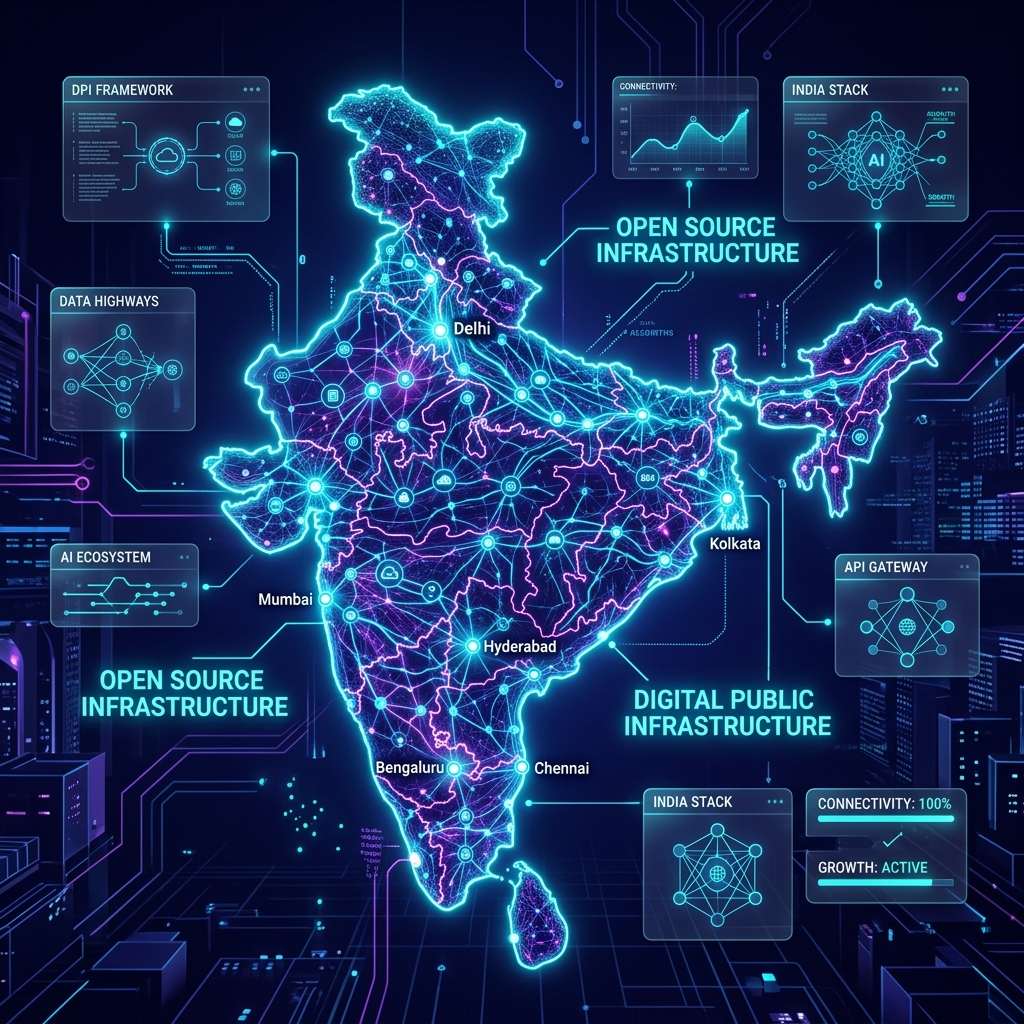
Ten years ago, a company choosing to "go open source" was a cost-saving software architecture decision. Today, it is a strategic maneuver. Open source has transformed from mere code-sharing into the foundational operating layer for artificial intelligence, cloud orchestrations, and massive digital public infrastructures (DPI). And nowhere is this evolution more critical than in India's booming tech sector.
Why are recurring global events like the Linux Foundation's Open Source Summit India, Open Source India, and the UN Open Source Week gaining so much traction? Are they just networking meetups? No. These forums have become the architectural drawing boards where builders, policy leaders, and enterprise teams negotiate the future of AI tooling, governance, interoperability, and community-driven innovation.
The Paradigm Shift: From Code to Full-Stack Innovation
The open-source conversation has shifted radically. We are no longer just discussing Linux distributions or Javascript libraries. Today, the biggest discussions revolve around how open models, open infrastructure, and open governance can accelerate AI adoption, prevent catastrophic vendor lock-in, and make complex digital systems reusable across entirely different economic sectors.
This is especially relevant in India, where the technology ecosystem is moving incredibly fast across startups, enterprise IT, government programs, and massive developer communities. Events like Open Source Summit India act as recurring checkpoints for the country’s software trajectory, while global forums like UN Open Source Week connect those exact same themes to international digital cooperation.
The India Ecosystem: Scale Meets Infrastructure
India has emerged as one of the most active markets for open-source participation globally. The reasons are simple: a massive, highly skilled developer base, a cost-sensitive enterprise culture, and an aggressive focus on AI-ready infrastructure.
Open Source Summit India
Designed for maintainers, infrastructure engineers, and community leaders. It is a practical coordination point for the ecosystem, with heavy emphasis on CI/CD, cloud orchestration, containers, and, crucially, Open AI & Data tracks.
Open Source India
Rooted deeply in the broader developer community, accelerating deployment across the subcontinent. It acts as a massive bridge between individual contributors, enterprises, and community maintainers at an incredible scale.
UN Open Source Week
Links open source to public infrastructure and international policy. It treats open source as a tool for digital public infrastructure (DPI), inclusive innovation, and sustainable development on a global governance scale.
AI Infrastructure is Open by Design
The phrase “AI infrastructure” can sound abstract, but it encompasses the tangible realities of compute scaling, model accessibility, deployment orchestration, data pipelines, and governance tooling. A major signal from UN Open Source Week was the intense focus on "Open Source for AI and Emerging Technologies."
The Full AI Stack
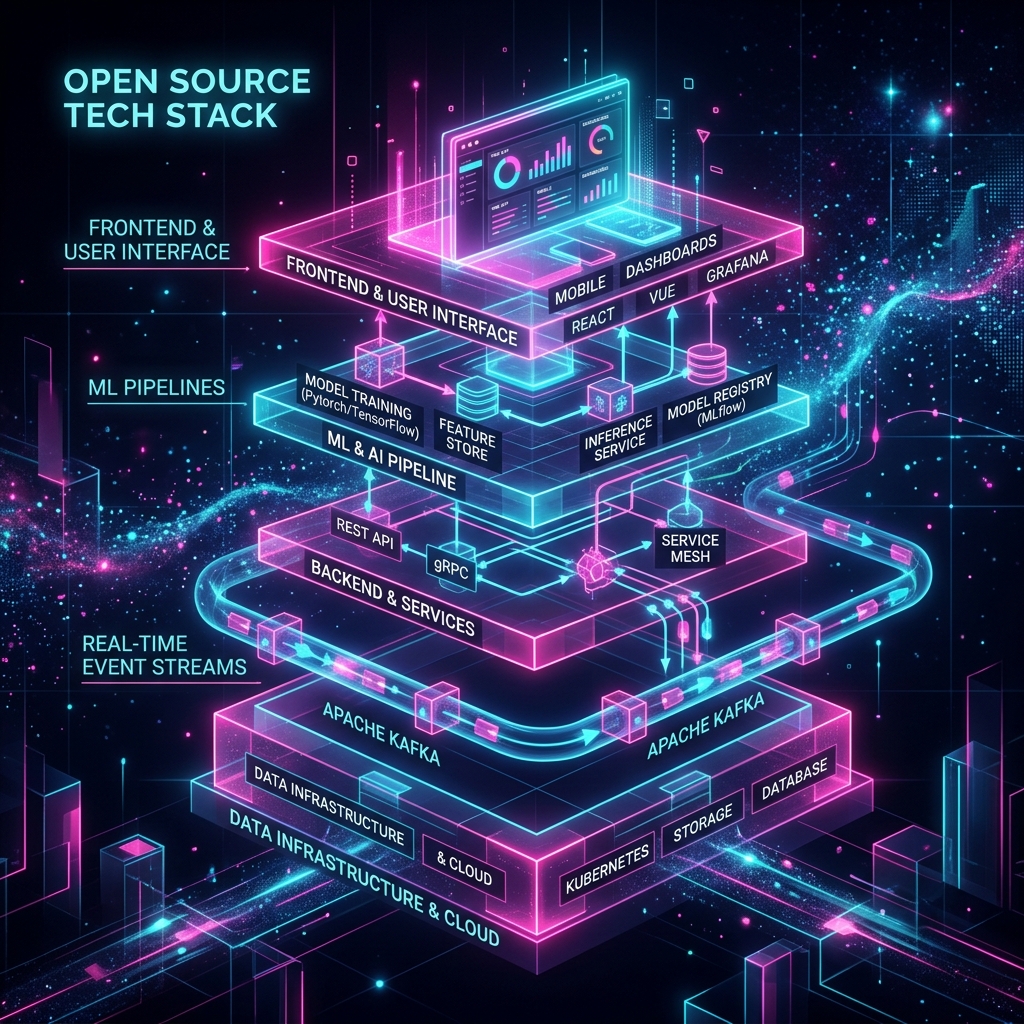
Open-source AI is no longer just about open model weights (like Llama or Mistral). It is about the full stack—data curation, training frameworks, inference engines, localized deployment tooling, and safety protocols. Open infrastructure is essential for AI at scale because it allows teams to modify models, inspect behaviors, and localize tools without black-box restrictions.
Digital Public Infrastructure (DPI)
Another major theme from UN Open Source Week was Digital Public Infrastructure. DPI positions open source as a critical enabler of the digital economy. It emphasizes that scale and governance must be combined—public infrastructure is only effective when it is highly reusable, aggressively interoperable, and fully inclusive.
This is particularly relevant to India (often cited via the India Stack: Aadhaar, UPI, DigiLocker). India’s public digital systems have proven how massive technology can work when built around open standards, standardized APIs, and shared rails. When global forums discuss DPI, India serves as the benchmark reality for large-scale implementations.
OSPOs & Institutional Maturity
Open source at an enterprise or national scale is rarely sustained by volunteers alone. Institutions require rigorous processes for contribution, licensing, governance, and security reviews. Enter the OSPO (Open Source Program Office).
| OSPO Function | Business Value |
|---|---|
| Governance & Licensing | Ensures legal compliance and mitigates IP risks when utilizing third-party libraries. |
| Security Review | Systematizes vulnerability patching and software bill of materials (SBOM) tracking. |
| Community Contribution | Formalizes how developers give back, attracting top engineering talent. |
UN Open Source Week highlighted "OSPOs for Good," showcasing their value in advancing sustainable development. For startups and large Indian IT organizations alike, OSPOs are becoming mandatory as AI adoption forces companies to formalize how they use and contribute to open source.
The Changing Developer Tooling
The modern open-source stack is vastly different from a decade ago. It now heavily integrates cloud orchestration (Kubernetes), containerization ecosystems, advanced CI/CD pipelines, AI coding assistants, and complex data streaming platforms like Kafka.
Developers are now expected to manage application code, cloud infrastructure, and AI model endpoints inside the same environment. Open source offers the flexibility required to build these modern workflows without being entirely dependent on proprietary cloud vendors.
Strategic Takeaways for Builders & Businesses
The biggest shift visible across India and global forums is that open source has become infrastructure, not just ideology. It now sits at the center of AI development, digital public systems, and modern software engineering.
What Developers Should Watch
- Open AI Stacks: Expansion of local models, AI safety, and deployment tooling.
- Infrastructure Tooling: Cloud-native automation, container ecosystems, and CI/CD remain the backbone of scalable software.
- Public Systems: DPI, OSPOs, and open governance are moving from niche topics to mainstream engineering.
What Businesses Should Watch
Businesses should see these events as market signals. Prepare for more open tooling in AI workflows, more scrutiny around data and model governance, and more collaboration with upstream communities. Open source lowers costs and speeds up innovation, but only if organizations put real effort into contribution and maintenance.
Industry Q&A
Why are recurring events like Open Source Summit so important?
What exactly is DPI (Digital Public Infrastructure)?
Why do companies need an OSPO?
Conclusion: Looking Ahead
If current trends continue, upcoming editions of these major forums will place even greater weight on open AI models, safety protocols, local language inference systems, and the governance frameworks required for DPI. Open source has unequivocally become the core infrastructure of the future.
For developers, builders, and investors, the message is clear: The future of technology is not just being built in isolated corporate labs. It is being architected in open communities, standardized in global consortiums, and deployed through massive public-interest forums.