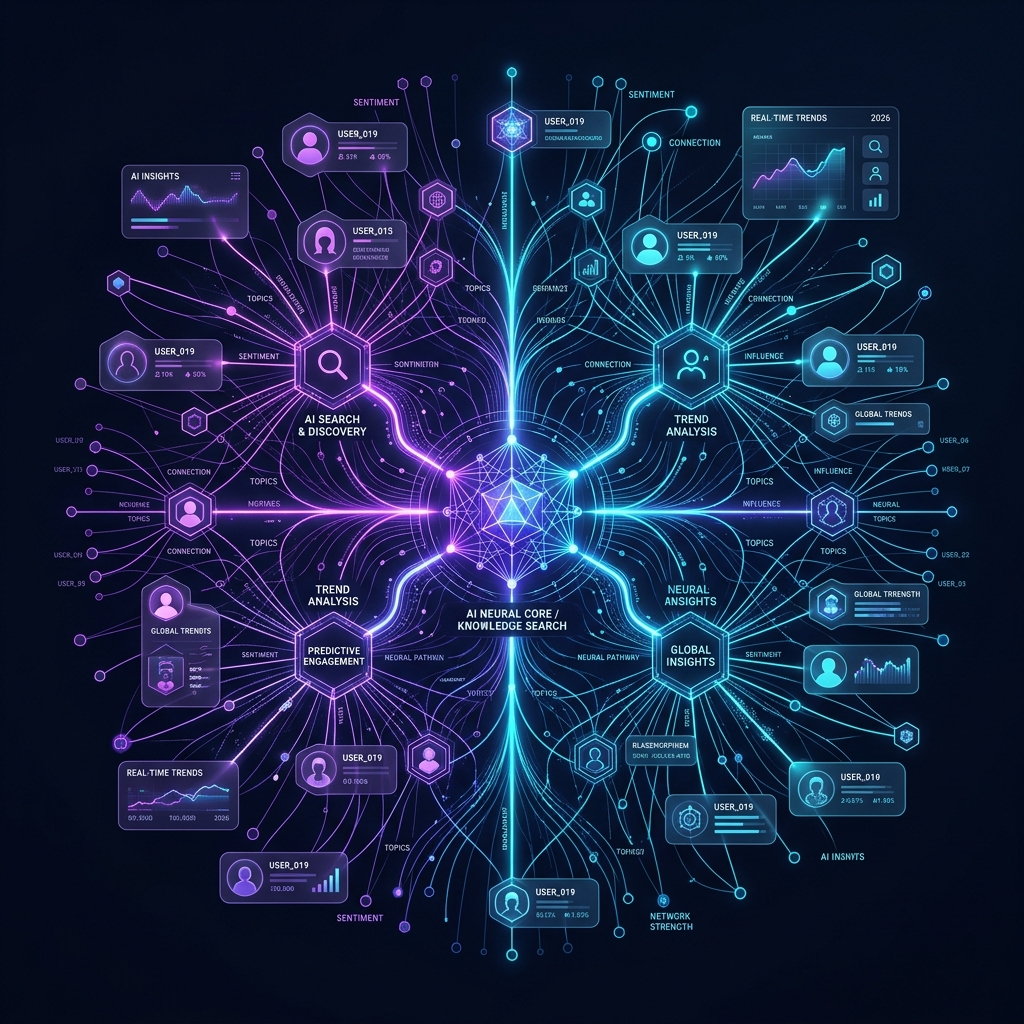
A curious thing happened in the last few years: social media stopped being “just social.” It became a search engine, a shopping assistant, a news filter, a customer service channel, a creator economy, and increasingly, an AI-powered decision layer for how people discover the world. If you are still thinking about social media as a place to post and hope, 2026 is the year that mindset becomes expensive.
What happens when the same platform that entertains your audience also helps them compare products, verify claims, watch reviews, and make buying decisions in seconds? That is the question every brand, founder, and investor should be asking right now. The answer is simple and disruptive: the companies that understand social media as an AI-native discovery system will outperform the ones still treating it like a vanity channel.
The New Social Reality
Social media in 2026 is not defined by one platform or one format. It is defined by a shift in how attention is created, how trust is earned, and how discovery works. Hootsuite’s 2026 trends report highlights that social is becoming a first-party data and research engine, while Sprout Social points to social search and video as central forces shaping behavior across platforms.
That means a social post is no longer just content. It is a searchable asset, a trust signal, a customer touchpoint, and in some cases, a conversion event. For businesses, this changes the economics of content: the same asset can now influence discovery, engagement, and purchase intent simultaneously.
Why 2026 Feels Different
The biggest change is not merely that AI is everywhere. It is that AI has moved from novelty to infrastructure. Hootsuite calls AI tools “table stakes,” and Sprout Social says AI-generated content is becoming mainstream, while AI agents are beginning to execute parts of social workflows.
The Skeptical Consumer
At the same time, consumers are getting more skeptical. Hootsuite notes that nearly a third of consumers say they are less likely to choose a brand that uses AI ads, and Sprout reports concern around undisclosed AI-generated content. In other words, the market is not rejecting AI; it is rejecting soulless AI, hidden AI, and AI that erodes trust.
The Three Forces Reshaping Social
AI is Automating the Workflow
AI is now used across ideation, drafting, analytics, and customer interaction. Pew Research shows that even teens are using AI chatbots widely for information seeking, schoolwork, and entertainment. But speed alone is not the advantage—the advantage comes from using AI to reduce friction while keeping humans in control of strategy, taste, and brand direction.
Authenticity is the Differentiator
As AI content floods feeds, audiences reward what feels real. Hootsuite explicitly says human-made authenticity wins. Trust is now a competitive moat. In a world where synthetic content is cheap and abundant, the brands that sound human, show real experience, and communicate clearly will build stronger long-term value.
Social Search Replaces Old Habits
Nearly one in three consumers skip Google and start their search journey on TikTok, Instagram, or YouTube (Sprout Social), and it's even higher among Gen Z. Google has also started indexing public Instagram content and short-form video. Social content must now be built for search intent and answerability.
The modern social platform is becoming three things at once: a discovery engine, a trust engine, and a conversion engine. This triple role matters because it compresses the customer journey. A user may discover a brand through a short video, verify credibility through comments and creator responses, and then convert after watching a second piece of content or reading a community discussion.
The AI Layer & Market Opportunities
AI is not just changing how content is made; it is changing what social platforms can do. Hootsuite notes that AI is powering predictive analytics, rapid experimentation, and more nuanced algorithms, while Sprout points to AI agents that may eventually manage multi-step social workflows.
| High-Value AI Categories | Business Impact |
|---|---|
| Content Generation & Creative | Reduces labor costs and scales production, provided human taste remains the final filter. |
| Social Listening & Sentiment | Identifies emerging trends and brand crises in real-time before they scale. |
| Audience Segmentation | Hyper-personalizes the discovery and conversion paths, reducing customer acquisition costs. |
| Community Management | Automates responses and support handling, improving responsiveness. |
| Performance Analytics | Uses predictive forecasting to map social signals directly to sales systems. |
Each of these areas reduces labor, increases speed, and improves decision-making. Investors are watching social AI not just as a marketing category, but as an operating layer for digital business.
Why Authenticity Wins in an AI World
The irony of the AI era is that the more synthetic the feed becomes, the more valuable imperfection becomes. Hootsuite points out that even typos, pauses, and natural pacing can signal authenticity, while Sprout's reporting shows brands moving toward relatable, human content.
What Authenticity Looks Like: It is not random behind-the-scenes footage alone. It is a system of signals: real people, real opinions, consistent values, visible expertise, and content that feels like it was created by someone who understands the audience deeply. Users are more comfortable with AI behind the scenes than with AI pretending to be a person.
Social Search Becomes Strategy
Social search is one of the most important underappreciated shifts of 2026. Users are increasingly using TikTok, Instagram, YouTube, and emerging platforms to search for answers, tutorials, reviews, and purchase guidance. Discovery is becoming more multimodal, including visual and voice-based search.
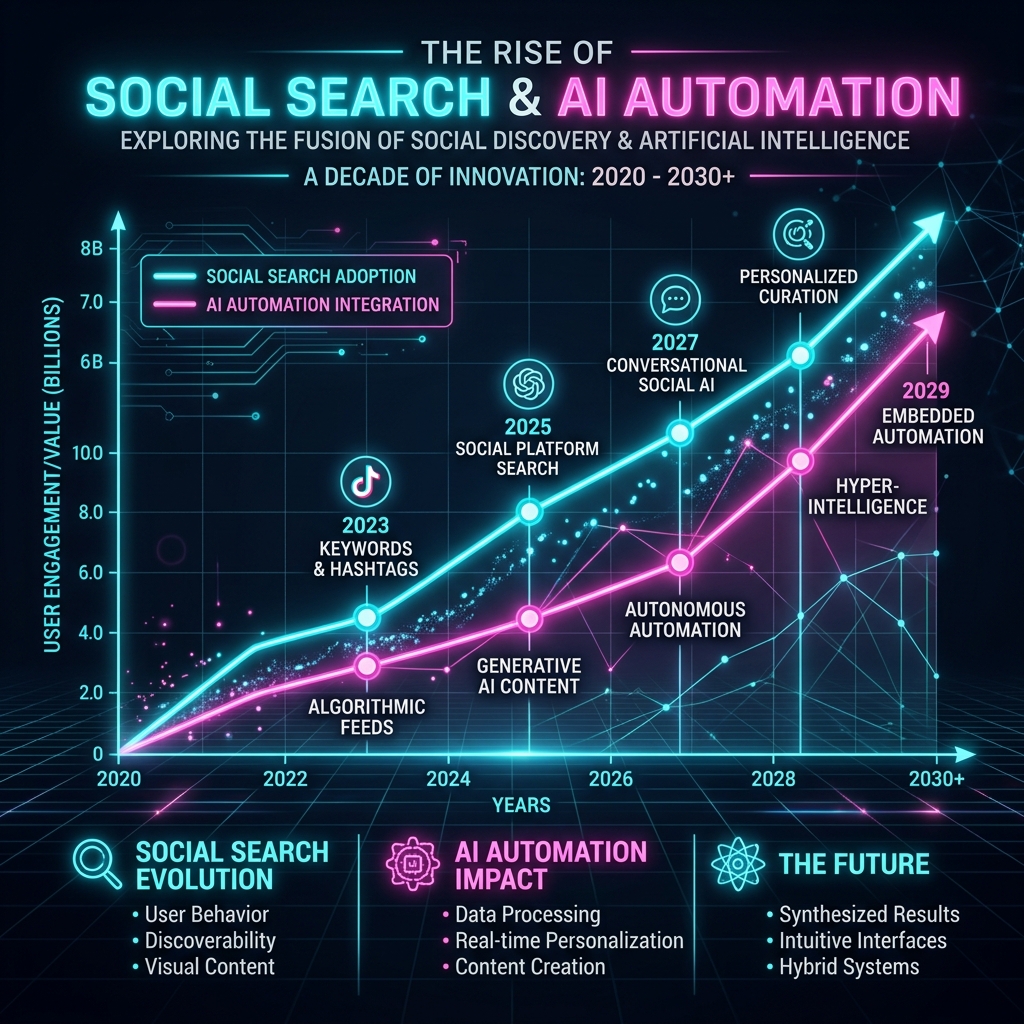
If a brand wants visibility in social search, it must optimize for:
- ✦ Clear keyword themes.
- ✦ Natural-language questions.
- ✦ Topic clusters across posts.
- ✦ Video captions and subtitles.
- ✦ Strong opening lines that state value quickly.
This is not traditional SEO copied onto social. It is a new form of discovery design where relevance, clarity, and format all matter together.
Video, Community, and Serialized Content
Video Still Dominates
Video is the default format for demonstrations, education, and brand identity. It is expensive to produce manually, creating massive upside for AI-assisted editing and analytics tools.
Community Over Virality
Viral reach without trust produces weak business outcomes. Community-driven brands generate repeat interactions, lower acquisition costs, and survive algorithm shifts far better than those relying solely on paid distribution.
Serialized Content
Audiences increasingly want recurring formats. Serialized content builds expectation, improves retention, and turns marketing into true programming.
The Business Model Shift & The Investor Lens
Social media is no longer just a marketing channel; it is a business infrastructure layer affecting sales, support, product feedback, hiring, and market intelligence. This opens the door to massive enterprise value. Companies that sit between the audience and the business decision can become extremely valuable.
From an investor’s perspective, the 2026 social media landscape is attractive because it sits at the intersection of several massive markets: AI, Digital Advertising, Creator Economy, Search, and Commerce. Every major platform is trying to own more of the user journey, creating opportunities for software companies that make the ecosystem smarter and more measurable.
The Strategic Playbook for Brands
- Can people find this content when they search?
- Does it feel human enough to trust?
- Is AI making the process better without making the output generic?
- Does it build repeat attention, not just one-time reach?
Technology and Engineering Behind Social Media in 2026
To understand these trends, you must look beneath the content layer. The real story is the engineering stack: ML ranking systems, real-time event pipelines, multimodal search, AI generation tools, and trust architecture. Social platforms now behave less like publishing tools and more like distributed intelligence systems that decide what people see, when they see it, and what they do next.
The Core Stack
A practical modern social media stack often includes:
- Frontend apps: React, Next.js, Flutter, Swift, or Kotlin.
- APIs & Event Streaming: Node.js, Go, Python, Java coupled with Kafka or Pulsar.
- Datastores & Search: PostgreSQL, MongoDB, Redis, OpenSearch, Elasticsearch, or vector databases.
- ML Pipelines: Feature stores, embedding models, and model-serving layers.
AI as the Operating Layer
AI is running inference at multiple points simultaneously. Systems must generate draft content, recommend the best format/time, classify content for safety/spam, predict conversion probability, and personalize discovery based on inferred intent.
Social Search Engineering
Social search requires indexing context and intent, not just keywords. A robust engine needs transcript indexing, caption parsing, OCR for on-screen text, image understanding, and semantic embeddings. This allows the system to map a query like "best travel camera" across videos, reviews, and creator posts seamlessly.
Building for Social Search requires: Full-text indexing, Semantic search using embeddings, Voice-to-text pipelines, Computer vision for image/video tagging, Ranking signals (watch time, saves, shares), Freshness scoring, and Trust scoring. SEO becomes engineering.
Real-Time Systems & Trust Infrastructure
Authenticity is an engineering problem as much as a marketing one. Platforms must support transparency signals, creator provenance, watermarking, content origin tags, and real-time fraud/deepfake detection. Trust is now part of the product. The more AI appears in the social stack, the more valuable trust infrastructure becomes.
Scaling recommendation engines, preventing bot abuse, maintaining latency under traffic spikes, and moderating multimodal content at scale are the defining technical challenges of the era.
Industry Q&A
Is traditional SEO dead?
How do we balance AI speed with Authenticity?
Why are teens so critical to understanding AI trends?
Conclusion
Brands should urgently audit their content for search visibility, authenticity, and AI readiness. That means tightening messaging, building recurring formats, and using AI for operational efficiency rather than voice replacement.
Investors and builders must watch the infrastructure that makes social easier to search, easier to trust, and easier to convert. As platforms transform into AI-native discovery engines, the companies providing the intelligence, trust, and workflow layers will become the most valuable entities in the digital business landscape.