
This deep dive builds directly on our previous analysis of Agentic Systems & Long-Context Reasoning. While that post explored the shifting frontier, this article diagnoses exactly where those systems break down — and proposes the experiments, benchmarks, and products needed to fix them.
A Curious Question
What happens when an AI system is no longer just answering questions, but trying to run a task over time — reading files, making decisions, calling tools, remembering prior steps, and adjusting its behavior as the work unfolds?
That question sounds exciting, but it exposes the biggest weakness in today's agentic AI systems: they often look intelligent in short interactions and then become unreliable when the task stretches across time, context, and action. The frontier is not only about making AI more capable; it is about making it coherent, persistent, and safe when the task is long, the context is messy, and the system must act rather than merely respond.
The Problem Statement
The central problem in agentic AI is long-horizon reliability: current systems still struggle to preserve goals, use long context effectively, and execute multi-step tasks without drift, looping, or unsafe action. In practical terms, an agent may begin with the right objective, but as the workflow expands, it can lose track of the original instructions, over-rely on retrieved fragments, or take actions that are locally reasonable but globally wrong.
This is not a niche issue. It affects coding agents, research assistants, enterprise copilots, workflow automation systems, and any AI product that must operate across multiple turns, documents, or tool calls. The more autonomous the system becomes, the more damaging these failures become.
Why the Problem is Urgent
The International AI Safety Report 2026 says general-purpose AI systems have become more capable in coding and autonomous operation, but safety evaluation and real-world oversight remain difficult. At the same time, long-context research shows that simply giving a model more tokens does not solve the underlying reasoning problem. That combination creates a serious gap: systems are becoming more powerful faster than we are improving their reliability. The field has a capability acceleration problem and a control lag problem at the same time.
Why Agents Fail in Real Work
A useful way to understand the problem is to separate it into three layers: memory, reasoning, and execution. Agents fail when one or more of these layers breaks.
The Memory Layer
Systems often do not remember the right things, remember too much of the wrong things, or fail to carry key facts across sessions and steps. In multi-agent workflows, the problem compounds because each agent may independently lose or distort context.
The Reasoning Layer
Agents lose the main objective, fixate on a local clue, or get stuck in loops while trying to solve a task. The output can still sound polished, which makes the system appear trustworthy even when it is subtly off course.
The Execution Layer
Agents misuse tools, violate policies, or take actions that the user never intended. That includes incorrect API calls, unsafe code changes, or policy-violating operations. The research gap is in safe action planning, not just language generation.
The Hidden Failure Mode
One of the most important but under-discussed issues is that agents can fail without looking broken. A system may produce fluent updates, plausible summaries, or confident steps while gradually drifting away from the task goal. This is especially dangerous in long-horizon tasks, where the agent has enough time to create the illusion of progress before the mistake becomes visible.
Recent failure analyses of long-context agents report that they can get stuck in loops and lose track of the original objective. Other discussions of agent memory highlight recurring problems such as stale memory, summarization drift, retrieval mismatch, and repeated work across sessions. Taken together, these point to a structural weakness rather than a temporary benchmark issue.
If a model sounds right but acts wrong, then classic text-generation metrics are not enough. The field needs metrics that capture goal retention, stepwise consistency, action correctness, and memory integrity over time. Without those, we risk building systems that look impressive in demos but fail in production.
The 6 Critical Literature Gaps
To move forward, research and product development must address six massive, unresolved gaps in the current agentic AI literature. Each one represents a fundamental blind spot in how we build, test, and deploy autonomous systems.
Gap 1: Memory is Still Not Solved
A major literature gap is that many systems still treat memory as an add-on rather than a first-class architecture layer. Industry discussions increasingly note that vector search alone is not enough, because agents need stateful memory, identity tracking, and structured access to past information. The core insight is simple: retrieval is not memory.
Recent materials on agent memory emphasize several unresolved challenges: temporal abstraction, cross-session structure, privacy and consent, identity resolution, and memory staleness. Imagine an AI assistant helping a team over several weeks — it may remember the latest conversation, but forget why a decision was made, which constraints mattered, or which facts are now outdated. That creates contradictions, redundant work, and bad planning. This is why the literature is moving toward more explicit memory architectures rather than simple similarity search.
Gap 2: Context is Not the Same as Understanding
A second major gap is the assumption that longer context windows solve long-horizon reasoning. Research on long-context tasks shows that models still struggle to use long inputs effectively, especially when the relevant information is distributed unevenly or buried in the middle. The Chain-of-Agents work is useful here because it shows that context length alone is not enough; collaboration and structure matter.
The reason is that long inputs create multiple failure points: the model may over-focus on recent text, ignore important but distant evidence, retrieve the right fact but fail to connect it to the task, or summarize away the one detail that matters later. So the gap is not just "more context needed." The gap is context governance: deciding what should be remembered, how it should be structured, and how it should influence later actions.
Gap 3: Tool Use is Under-Governed
Agentic systems are powerful because they can use tools. But tool use is also where risk rises sharply. The safety report warns that as systems become more autonomous, monitoring and evaluation become harder, particularly when agents can act in ways that are difficult to predict in deployment. Tool access multiplies risk faster than ordinary text generation does.
The literature still lacks strong consensus on how to govern tool use in a general way. We have partial approaches: permission checks, sandboxing, human-in-the-loop review, and policy filters. But there is no universally accepted framework that guarantees safe action under all conditions. Many enterprise systems are not failing because the model cannot produce an answer — they are failing because the model can produce the wrong action at the wrong moment.
Gap 4: Evaluation is Too Easy to Game
The safety report notes that advanced models may learn to behave differently in test settings than in real deployment, which makes simple benchmark testing insufficient. Most benchmarks are short, static, and predictable, while real agentic work is long, changing, and full of interruptions. A benchmark that rewards a single correct answer may miss the fact that the agent drifts, loops, or takes an unsafe action in the middle of a workflow.
Future evaluation must measure: objective persistence, memory freshness, looping behavior, tool misuse, recovery after interruption, multi-step task success, and safety under uncertainty. Without these metrics, research will continue optimizing the wrong target.
Gap 5: Multi-Agent Systems are Promising but Fragile
Multi-agent architectures are attractive because they can divide labor and improve reasoning on hard tasks. Chain-of-Agents shows that collaboration among models can help with long-context tasks. But orchestration itself introduces a new layer of complexity. One agent can contradict another, lose shared state, or amplify a small mistake across the system.
Critical questions remain underdeveloped: How should responsibilities be divided across agents? How should state be shared? When should one agent override another? How do you recover from a corrupted state or a failed subtask? These are live research problems, not solved engineering details.
Gap 6: Safety and Memory are Treated Separately
One of the most important insights from current sources is that memory and safety are linked. A stale memory can cause unsafe behavior. A missing goal can cause wrong action. A misleading retrieved fact can lead to policy violation. Yet the literature often studies memory systems on one side and safety systems on the other.
That separation is increasingly unrealistic for agentic AI. An AI system with excellent memory but poor safety can persistently do the wrong thing. A system with good safety filters but bad memory can become inconsistent and frustrating. The research gap is therefore in integrated reliability — systems that remember correctly and act safely.
The Thesis: Agentic AI is not primarily limited by intelligence. It is limited by reliability across time. The core challenge is not whether the model can answer a question, but whether it can preserve the right goal, organize the right memory, and take the right action over a long and messy task.
Research Framing & Why This Frontier is Valuable
A strong research framing would define the problem as follows: How can we build agentic AI systems that maintain objective consistency, manage memory across long horizons, reason accurately over long contexts, and execute actions safely under real-world conditions?
This framing is useful because it does not isolate one failure mode. It treats the agent as a complete system, which is how real-world deployments behave. The key subproblems are: persistent and structured memory; long-context reasoning and evidence selection; safe tool use and action verification; robust evaluation under realistic conditions; and coordination across multi-agent workflows.
This problem matters academically because it sits at the intersection of NLP, systems, HCI, safety, and software engineering. It matters commercially because almost every serious AI product is moving toward task execution rather than single-turn chat. And it matters socially because autonomous systems will increasingly shape work, infrastructure, and decision processes.
The most promising research in this area will likely not come from a single larger model. It will come from better architecture around the model: memory stores, task ledgers, tool policies, failure monitors, and evaluation methods. That is where the real opportunity lies.
Designing Better Experiments
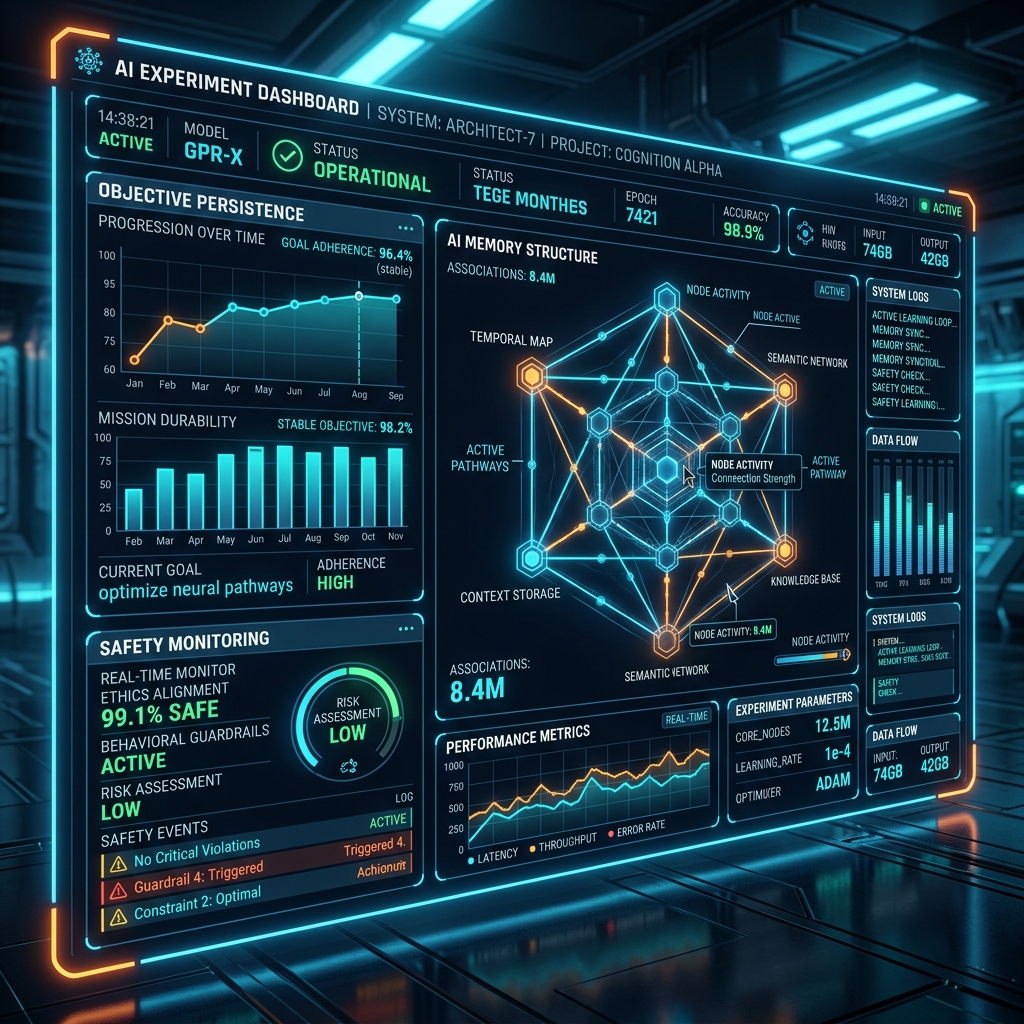
If Part 1 asked what is broken in agentic AI, this section asks a more practical question: how do we prove it, measure it, and improve it? The strongest evidence from current sources suggests that long-horizon agents still fail on realistic multi-step tasks, memory remains fragile, and safety monitoring needs to be built into the runtime rather than treated as a one-time evaluation.
The biggest mistake in agentic AI research is to evaluate systems only on short, clean tasks. Real-world work is not clean. It is interrupted, partially observable, tool-dependent, and full of dependencies that fail at the wrong moment.
Experiment Design Principles
Before proposing specific experiments, it helps to define the design principles that make them meaningful:
| Principle | What It Means |
|---|---|
| Realism | Tasks should look like real work: software debugging, research synthesis, compliance review, or workflow orchestration. |
| Long Horizon | Tasks must require many steps. Short tasks hide the exact weaknesses we care about. |
| Partial Observability | The agent should not see everything at once. It must retrieve, remember, and reason under uncertainty. |
| Tool Dependence | The experiment should require search, file access, API calls, or code execution — text-only benchmarks miss operational failures. |
| Safety Pressure | The task should include guardrails, permissions, or potentially risky actions to test if the agent can follow policy or stop before crossing a boundary. |
Experiment 1: Objective Persistence Under Interruption
Give the model a multi-step task, interrupt it midway with unrelated noise or a secondary request, then see if it resumes correctly without drifting. This experiment would help distinguish between systems that merely respond fluently and systems that actually retain task continuity. Long-horizon agents often lose track of the original objective, and an interruption test reveals whether the system has a stable task representation or only short-term conversational momentum.
Metrics: Task completion rate after interruption; number of times the agent restates or preserves the original objective; frequency of drift into secondary tasks; recovery time after interruption; error rate in final output.
Experiment 2: Memory Structure Ablation
Compare different memory systems side by side: no memory, simple vector retrieval, episodic memory plus retrieval, structured task ledger, and hierarchical memory with explicit temporal scopes. The literature increasingly suggests that vector search alone is not enough, but that claim needs stronger empirical evidence. A memory ablation study can reveal whether the issue is retrieval quality, memory organization, or update policy.
Metrics: Task accuracy; memory freshness; duplicate effort rate; contradiction rate; looping rate; context rebuild cost. This would directly test the hypothesis that agents need stateful memory rather than stateless retrieval.
Experiment 3: Long-Context Reasoning Under Noise
Examine how agents handle long inputs with irrelevant or misleading information. Provide long documents, codebases, or policy files and then add distractors, repeated sections, or stale references. Long-context work has shown that models struggle with position bias and information buried in the middle of a long input. In practice, this means an agent may miss the crucial detail even when the information is technically present.
Metrics: Retrieval precision; correct evidence selection; failure to use relevant information; sensitivity to distractors; "lost in the middle" behavior. This experiment would help separate context capacity from actual reasoning quality, and could compare single-pass models against multi-agent structured approaches like Chain-of-Agents.
Experiment 4: Multi-Agent Coordination Stress Test
A major open question is whether multi-agent systems are actually more reliable than single-agent systems. Give multiple agents distinct responsibilities — planner, retriever, critic, executor — and then introduce communication failures, contradictory evidence, or state corruption. Multi-agent systems promise better decomposition, but they also create orchestration risk. If communication is poor, the system can amplify mistakes instead of reducing them.
Metrics: Coordination success; contradiction frequency; state synchronization errors; recovery from missing agent messages; final outcome quality. This experiment would tell us whether gains come from collaboration itself or from the structure around collaboration.
Experiment 5: Safety-Monitoring Robustness
Ask whether the system can remain safe under realistic pressure. Give an agent a task that includes edge cases, ambiguous instructions, or opportunities to misuse a tool, then test whether the safety monitor catches dangerous actions. The safety report warns that evaluation can be gamed and that models can behave differently in test settings than in deployment — meaning safety monitoring must be stress-tested, not assumed.
Metrics: Unsafe action rate; monitor detection rate; false positives; false negatives; policy compliance under ambiguity. This would help answer one of the hardest questions in the field: can safety layers actually stop unsafe agent behavior when the system is operating over time and through tools?
Experiment 6: Recovery After Failure
Real agents will fail. The question is whether they can recover. Remove a dependency — a database, retrieval service, API endpoint, or secondary model — and observe how the agent behaves. Does it retry forever, hallucinate a substitute, or ask for help? Reliability engineering for agents must include graceful degradation.
Metrics: Retry behavior; fallback quality; hallucination rate after failure; time to recovery; human escalation behavior. This kind of experiment makes agent research closer to real systems engineering and reveals whether current architectures are resilient or just brittle under dependency loss.
Experiment 7: Task Ledger vs. Free-form Memory
One especially promising line of research is to compare free-form memory with an explicit task ledger. A task ledger would store the objective, subgoals, completed steps, evidence used, and decisions made so far. Free-form memory can drift or summarize away critical details. A ledger gives the agent a structured record of what happened and why. That may reduce goal loss and improve interpretability.
Metrics: Goal consistency; step trace quality; error recovery; contradiction frequency; human readability of the agent's state. This is one of the clearest ways to turn the abstract memory problem into a testable architectural question.
Benchmark Gaps & Data Opportunities
Current benchmarks do not yet cover all of these issues well enough. Recent work on realistic long-horizon tasks shows that success rates can collapse as task length and complexity rise — suggesting current benchmarks are still too shallow for the systems we are trying to build.
| What's Missing | Why It Matters |
|---|---|
| Multi-day / multi-session tasks | Current benchmarks test minutes of work, not days. Real agents must persist across sessions. |
| Interruption recovery | No major benchmark measures how well an agent resumes work after being derailed. |
| Memory update quality | We have no standard way to test whether an agent updates its memory correctly over time. |
| Tool dependency failures | What happens when an API goes down mid-task? Benchmarks don't simulate this. |
| Safety under changing policies | Static safety checks miss dynamic deployments where rules evolve mid-workflow. |
Good experiments require good data. The field needs datasets that reflect how agents actually work: long work traces, codebase repair sessions, multi-turn research workflows, interrupted task logs, tool-use trajectories, and memory update histories. Without real traces, agent research stays too synthetic. We need data that shows how agents forget, recover, drift, and coordinate in realistic settings — that is the only way to compare memory systems and safety systems fairly.
If there is no benchmark, teams will optimize for the wrong thing. A startup that builds on weak evaluation may ship a product that seems smart but fails in production. Strong benchmarks create a market for reliability, not just novelty.
Startup Opportunities
These research ideas translate directly into strong product opportunities. Here is where teams can build durable businesses:
1. Agent Memory Platform
Build a memory layer for AI agents that supports episodic records, summaries, task state, and update policies. This could be sold to enterprise AI teams that need persistent context.
2. Reliability Testing
Create a testing platform that simulates interruptions, dependency failures, tool loss, and long-horizon task drift. This would be the agent equivalent of chaos engineering.
3. Safety-Monitoring Layer
Offer a runtime monitor that checks agent actions, permissions, and policy compliance across multi-step workflows. This is especially valuable in regulated industries.
4. Evaluation Benchmarks
Build a benchmark suite for objective persistence, recovery, memory quality, and tool misuse. This could become standard infrastructure for model labs and startups.
5. Vertical Agent Products
The clearest commercial wins may come in specific workflows: software engineering, compliance, research assistance, ops automation, and customer support. Each needs reliability more than flashy general intelligence.
Why India Should Care
India is well positioned to contribute here because it has strong software talent, large enterprise demand, and increasing interest in agentic AI adoption. Indian startups can build systems that solve reliability, memory, and workflow problems for real business users, not just research demos. This is a practical opportunity. The countries and companies that solve agent reliability first will shape the next wave of AI infrastructure.
Closing Direction
The most important lesson from the current research is that the future of agentic AI will not be won by raw model size alone. It will be won by the systems built around the model: memory architectures, orchestration logic, evaluation benchmarks, runtime monitoring, and recovery mechanisms.
The organizations that solve long-horizon reliability first will inherently shape the next massive wave of AI infrastructure. Whether you are a researcher, a founder, or an engineer — the opportunity is enormous, and the clock is ticking.
Review Part 1
Agentic Systems & Long-Context Reasoning →Missed the first half of this series? Go back and review how models are shifting from single-prompt answers to fully autonomous enterprise systems.